
Drive past a wheat field in late August, just before harvest, and look closely at the heads of grain. The ones that filled out well hang heavy, bending toward the ground under the weight of the kernels. But here and there you’ll spot a few heads standing straight up, stiff and tall in the wind. From the road, those look like the strongest plants in the field. A farmer knows better. Those heads stand tall because there’s nothing in them.
Scripture paints the same picture of the human heart. The believer whom God has filled with grace bows low before Him, and the one who stands stiff and tall usually has the least to show for it. Pride can look impressive from the road, but “man looketh on the outward appearance, but the LORD looketh on the heart” (1 Samuel 16:7).
James wrote to Christians who were quarreling among themselves. He asked them, “From whence come wars and fightings among you?” (James 4:1), and then he traced the trouble all the way down to its root:
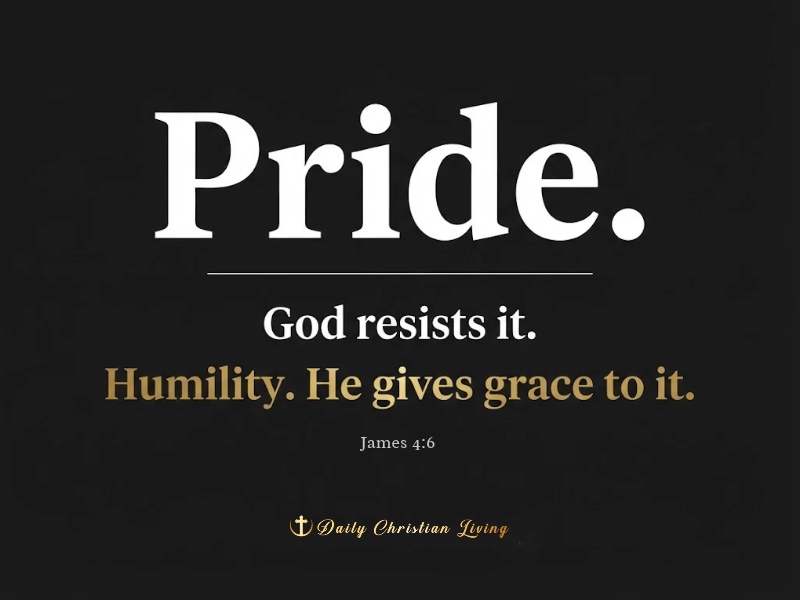
James 4:6 — “But he giveth more grace. Wherefore he saith, God resisteth the proud, but giveth grace unto the humble.”
That one verse sets the whole matter in front of us. God is either lined up against us or pouring grace on us, and the difference comes down to whether we stand tall before Him or bow.
What Does the Bible Say About Pride?
Pride is setting ourselves up in the place that belongs to God alone, trusting our own strength, wisdom, or goodness instead of His. Scripture calls it the devil’s first sin, puts a proud look first on the list of things the Lord hates, and warns that it comes before a fall.
Solomon gives a list of seven things the Lord hates, and look at what sits at the very top:
Proverbs 6:16–17 — “These six things doth the LORD hate: yea, seven are an abomination unto him: A proud look, a lying tongue, and hands that shed innocent blood . . .”
A proud look comes ahead of lying, and even ahead of murder. Of course, that doesn’t make pride worse than murder in every way, but it shows how seriously God takes it. Pride sits underneath so many other sins. A man lies to protect his image, he lashes out when someone bruises his ego, and he holds a grudge because he can’t stand to be wronged.
Pride also has a long history. It started before the Garden of Eden. In Isaiah 14 the prophet pulls back the curtain on the fall of Lucifer, and in two short verses Lucifer says “I will” five times: “I will ascend into heaven, I will exalt my throne above the stars of God . . . I will be like the most High” (Isaiah 14:13–14). He wanted God’s throne. Paul later warned that a new convert shouldn’t be rushed into church leadership, “lest being lifted up with pride he fall into the condemnation of the devil” (1 Timothy 3:6).
- Pride stirs up strife. “Only by pride cometh contention” (Proverbs 13:10). Many church fights, family feuds, and marriage blowups come down to two people who refuse to give an inch.
- Pride deceives the one who has it. “For if a man think himself to be something, when he is nothing, he deceiveth himself” (Galatians 6:3). The proud man is usually the last one to see it.
- Pride goes before a fall. “Pride goeth before destruction, and an haughty spirit before a fall” (Proverbs 16:18).
Why Does God Resist the Proud?
God resists the proud because pride competes with Him for glory He has said He will not share. The proud heart says it doesn’t need God, so it shuts itself off from grace. God sets Himself against that heart, but He pours grace on anyone humble enough to admit their need.
The Lord said it plainly through Isaiah: “I am the LORD: that is my name: and my glory will I not give to another” (Isaiah 42:8). Pride reaches for that glory anyway. It takes credit for what God gave, and it trusts in what God can take away overnight.
The word James uses for “resisteth” is antitassō, and it comes from the military. It means to line up in battle array against someone. So the proud man has more than God’s disapproval to deal with; he has the Lord of hosts drawn up against him like an army. Peter quotes the same truth with the same word in 1 Peter 5:5, which tells us the apostles took this seriously.
Nebuchadnezzar learned it the hard way. He was the most powerful man on earth, and God warned him in a dream. Daniel urged him to “break off thy sins by righteousness” (Daniel 4:27), and God gave him twelve full months to listen. Then one day, as the king walked in his palace, he spoke these words:
Daniel 4:30 — “The king spake, and said, Is not this great Babylon, that I have built for the house of the kingdom by the might of my power, and for the honour of my majesty?”
Count the “I”s and the “my”s in that sentence. While the words were still in his mouth, a voice fell from heaven (Daniel 4:31). He was driven from men, and he ate grass like an ox until seven times passed over him. By the time God restored his mind, the king had a new testimony:
Daniel 4:37 — “Now I Nebuchadnezzar praise and extol and honour the King of heaven, all whose works are truth, and his ways judgment: and those that walk in pride he is able to abase.”
Pride often waits until after success to show itself. King Uzziah started well, and God blessed him, “for he was marvellously helped, till he was strong. But when he was strong, his heart was lifted up to his destruction” (2 Chronicles 26:15–16). He pushed into the temple to burn incense, a job God gave only to the priests, and he left a leper and stayed one until the day he died. Agur saw that same danger when he prayed, “Lest I be full, and deny thee, and say, Who is the LORD?” (Proverbs 30:9). The seasons of blessing call for the most guarding.
What Is Biblical Humility?
Biblical humility is seeing God as He is and ourselves as we are, and then living like it. It shows up in a willingness to serve, to submit, and to put others’ needs ahead of our own. The perfect pattern is the Lord Jesus, who humbled Himself to the death of the cross.
Philippians 2:5–8 — “Let this mind be in you, which was also in Christ Jesus: Who, being in the form of God, thought it not robbery to be equal with God: But made himself of no reputation, and took upon him the form of a servant, and was made in the likeness of men: And being found in fashion as a man, he humbled himself, and became obedient unto death, even the death of the cross.”
The Son of God, equal with the Father, “made himself of no reputation.” He stepped down from heaven’s throne to a manger, from the manger to a carpenter’s bench, and from there to a Roman cross. Nobody forced a single one of those steps on Him. He chose every one.
Just before that passage, Paul uses the phrase “lowliness of mind” (Philippians 2:3). The Greek word is tapeinophrosunē, and in the Greek world of Paul’s day its root usually described something low, servile, or base, the cringing spirit you’d expect from a slave. Few Greeks would have called it a virtue. But the gospel took that word and, through the example of Christ, made it one of the marks of His people.
Watch the Lord in the upper room. John tells us that “Jesus knowing that the Father had given all things into his hands, and that he was come from God, and went to God” (John 13:3), rose from supper, took a towel, and began to wash the disciples’ feet. He knew exactly who He was. And out of that knowledge, He knelt down with a basin of water.
- Christ is the pattern. “Learn of me; for I am meek and lowly in heart” (Matthew 11:29).
- Humility serves. “If I then, your Lord and Master, have washed your feet; ye also ought to wash one another’s feet” (John 13:14).
- Humility walks with God. The Lord requires us “to do justly, and to love mercy, and to walk humbly with thy God” (Micah 6:8), one ordinary step at a time.
Does Philippians 2:3 Mean I Have to Think Less of Myself?
No. Philippians 2:3 calls us to put others’ interests ahead of our own, and Romans 12:3 tells us to think of ourselves soberly and accurately. Humility leaves room to admit what God has given us, and then it puts those gifts to work for others and for His glory.
Philippians 2:3 — “Let nothing be done through strife or vainglory; but in lowliness of mind let each esteem other better than themselves.”
Now, many of us read that verse and think, “Do I really have to believe everybody else is better than me at everything?” Maybe you’re the best welder in the shop. Maybe you’ve played piano at church for thirty years, and you know you play better than the teenager who just started last spring. Does humility mean pretending otherwise? If so, it would ask us to believe things that aren’t true, and God never asks His people to lie, even about themselves.
That’s an honest question, and it’s worth sitting with rather than rushing past. Well, the very next verse helps:
Philippians 2:4 — “Look not every man on his own things, but every man also on the things of others.”
Paul’s concern is whose interests come first. To esteem others better means to treat their needs as more important than our own comfort or credit. And Romans 12:3 fills in the rest. We’re not to think of ourselves “more highly than he ought to think; but to think soberly.” Sober thinking is clear-headed thinking. It doesn’t inflate what we are, and it doesn’t pretend we’re nothing either.
So go back to the upper room. The Lord knew all things had been given into His hands, and He still washed feet. The best welder in the shop can know he’s good at his trade and still be the first one to help the new guy, without needing anyone to notice.
How Do Christians Get Humility Wrong?
Christians usually miss humility in one of two directions. Some swallow the world’s teaching that we must learn to love ourselves first, which feeds the very pride Scripture condemns. Others put on a show of humility, running themselves down in public while quietly hoping to be noticed. Both errors keep our eyes on ourselves.
Is “Loving Yourself First” Biblical?
Walk through the self-help aisle of most bookstores and you’ll find the same idea over and over: you can’t love God or anyone else until you first learn to love yourself. Some pulpits have picked it up too, serving up therapy with a Bible verse stapled to the end. The verse they usually reach for is this one:
Matthew 22:39 — “And the second is like unto it, Thou shalt love thy neighbour as thyself.”
Read it carefully. Jesus gave two commandments here: love God with all your heart, and love your neighbor (Matthew 22:37–40). He never gave a third commandment to love yourself. “As thyself” assumes the self-love is already there and turns it outward. Paul said the same thing: “For no man ever yet hated his own flesh; but nourisheth and cherisheth it” (Ephesians 5:29). We feed ourselves when we’re hungry, and we bandage our own cuts. Jesus takes the care we already give ourselves and tells us to give the same to our neighbor.
Then look at how Paul describes the last days: “For men shall be lovers of their own selves, covetous, boasters, proud” (2 Timothy 3:2). Self-love heads the list, ahead of covetousness and pride. Any teaching that tells Christians their main problem is not loving themselves enough has the Bible backwards.
Can Humility Be Fake?
That said, there’s a ditch on the other side of the road too. Some believers have learned to put humility on like a costume. Paul warned the Colossians about teachers who made a big show of self-denial:
Colossians 2:18 — “Let no man beguile you of your reward in a voluntary humility and worshipping of angels, intruding into those things which he hath not seen, vainly puffed up by his fleshly mind . . .”
Look at how Paul describes them: “vainly puffed up.” Underneath the show of humility sat plain old pride. Jesus said the same about the hypocrites who disfigured their faces when they fasted, “that they may appear unto men to fast” (Matthew 6:16). Today it might be the person who runs himself down, hoping someone will jump in and disagree, or the Christian who makes sure everybody knows how much he gives up for the Lord. Actually, false humility still keeps a person thinking about himself all day long.
The Lord drew the contrast in a parable. The Pharisee “stood and prayed thus with himself” (Luke 18:11), reminding God how often he fasted and how faithfully he tithed. Then there was the publican:
Luke 18:13 — “And the publican, standing afar off, would not lift up so much as his eyes unto heaven, but smote upon his breast, saying, God be merciful to me a sinner.”
The publican wasn’t thinking highly of himself, and he wasn’t putting on a show of thinking lowly of himself either. His eyes were on the mercy of God.
How Can I Walk in Humility Today?
Humility grows as we remember that everything we have came from God and then live as we believe it. Taking the lower seat, serving where no one is watching, welcoming correction, and giving God the credit are daily habits that train a proud heart to bow.
- Remember where it came from. “What hast thou that thou didst not receive? now if thou didst receive it, why dost thou glory, as if thou hadst not received it?” (1 Corinthians 4:7). Your talents, your health, your job, and your next breath all came from God’s hand.
- Take the lower seat. Jesus told wedding guests to “go and sit down in the lowest room” and let the host call them higher (Luke 14:10). Let someone else go first, take the credit, or have the last word.
- Serve where nobody’s watching. Stack chairs after the fellowship dinner, visit the shut-in, and take a turn in the nursery. “Thy Father which seeth in secret himself shall reward thee openly” (Matthew 6:4).
- Welcome correction. “Whoso loveth instruction loveth knowledge: but he that hateth reproof is brutish” (Proverbs 12:1). That’s blunt, but it’s true. A proud man bristles when he’s corrected, and a humble man says thank you and makes the change.
- Brag on God. “But let him that glorieth glory in this, that he understandeth and knoweth me” (Jeremiah 9:24). When someone compliments your work, it’s fine to say thank you, and then point them to the Lord who gave you the ability.
Where Does Humility Begin?
Humility begins at the cross, where we admit we cannot save ourselves. Pride keeps many people out of heaven because it refuses to come to God as a sinner. Salvation is a gift received by faith in Jesus Christ, so no one will ever be able to boast about earning it.
The Pharisee went home with all his fasting and tithing, and he went home lost. The publican had nothing to offer God but his sin, and Jesus said, “this man went down to his house justified rather than the other: for every one that exalteth himself shall be abased; and he that humbleth himself shall be exalted” (Luke 18:14). Salvation has always worked that way. “For by grace are ye saved through faith; and that not of yourselves: it is the gift of God: Not of works, lest any man should boast” (Ephesians 2:8–9).
If you’ve never trusted Jesus Christ as your Savior, the first step is the humble one. Admit that you’re a sinner (Romans 3:23), believe that Jesus died for your sins and rose again, and call on Him to save you.
Romans 10:9 — “That if thou shalt confess with thy mouth the Lord Jesus, and shalt believe in thine heart that God hath raised him from the dead, thou shalt be saved.”
The promise is for anyone: “For whosoever shall call upon the name of the Lord shall be saved” (Romans 10:13). If you have questions, our Secure Salvation page walks through it step by step.
The same God who resists the proud stands ready to give grace to anyone who comes to Him with bowed head and empty hands, and that includes you today.
Father, we confess that pride has crept into our hearts more often than we care to admit. Forgive us for the times we have trusted our own strength and wanted the credit that belongs to You. Give us the mind of Christ, who humbled Himself for us, and teach us to serve others gladly. Keep our eyes on Your mercy instead of on ourselves. In Jesus’ name, amen.
No responses yet