
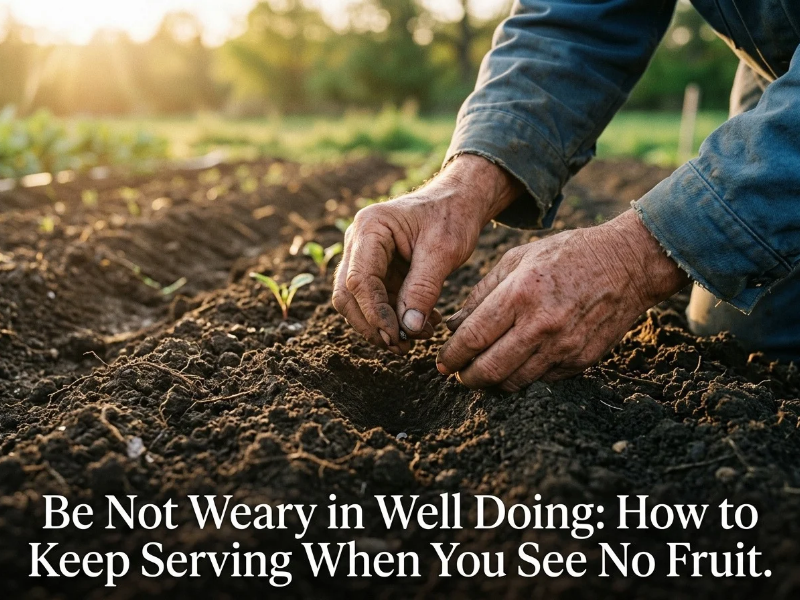
Drive through southern Minnesota in the middle of May, and you’ll pass mile after mile of fields where nothing seems to be happening. The ground has been worked, the seed is in, and all you can see is black dirt. A farmer could walk out to the edge of that field two weeks after planting and find no sign at all that he did anything.
But he doesn’t dig up the seed to check on it, and he doesn’t decide the whole thing was a waste and go plant something else. He knows what went into the ground, and he knows that seed is doing exactly what seed does, whether he can see it or not. So he waits. James describes him well:
James 5:7 — “Be patient therefore, brethren, unto the coming of the Lord. Behold, the husbandman waiteth for the precious fruit of the earth, and hath long patience for it, until he receive the early and latter rain.”
A lot of faithful Christians are standing at the edge of that field right now. The Sunday school teacher who has taught the same class of restless kids for years. The bus worker knocking on the same doors every Saturday morning. The mother who has prayed for a son who walked away from the Lord a decade ago. The deacon who keeps showing up and keeps serving, and who quietly wonders if any of it is making a difference.
If that sounds like you, the Holy Spirit wrote this verse with you in mind:
Galatians 6:9 — “And let us not be weary in well doing: for in due season we shall reap, if we faint not.”
What Does “Be Not Weary in Well Doing” Mean?
In Galatians 6:9, Paul tells believers not to lose heart in doing good to others. The harvest of their labor is certain, but it comes in God’s appointed season, not ours, and it belongs to those who keep going rather than quit before the reaping comes.
The verse sits right in the middle of a passage about sowing and reaping. Two verses earlier, Paul lays down a principle that’s as fixed as the seasons:
Galatians 6:7 — “Be not deceived; God is not mocked: for whatsoever a man soweth, that shall he also reap.”
Most of the time we quote that verse as a warning, and of course it is one. Sow to the flesh and you’ll reap corruption. But Galatians 6:9 takes the same law and turns it into a promise. If sowing sin brings a harvest, so does sowing good, and God doesn’t let either one go unreaped.
So what is the “well doing” Paul has in mind? Look at the verses on either side of it. Galatians 6:2 tells us to “Bear ye one another’s burdens, and so fulfil the law of Christ,” and Galatians 6:10 says, “As we have therefore opportunity, let us do good unto all men, especially unto them who are of the household of faith.” Well doing is the ordinary, unglamorous work of loving people: teaching, giving, visiting, praying, and showing up when somebody needs you.
- Paul said it more than once. He gave nearly the same command to the church at Thessalonica: “But ye, brethren, be not weary in well doing” (2 Thessalonians 3:13). Weariness in serving showed up in more than one first-century church, so you’re not the first believer to feel it.
- “Be not weary” means don’t lose heart. The Greek word is ekkakeō, which carries the idea of losing courage and giving in to discouragement. Paul is warning against a heart that slowly starts to give up on the work.
- The season belongs to God. “Due season” translates kairō idiō, literally “its own season.” The harvest has a time set for it, and God is the One who set it.
Why Do Faithful Christians Grow Weary?
Christians grow weary in well doing when they see no fruit, receive no thanks, face criticism, or try to serve in their own strength. Each of these is real and painful, but none of them means God has stopped working through their faithfulness.
Weariness in serving rarely shows up all at once. It builds a little at a time, week after week, until one Sunday morning you’d rather do almost anything than walk into that classroom again. Here are some of the most common reasons it happens.
- No visible fruit. You’ve poured yourself into the same people for years, and you honestly can’t point to one life that has changed. That’s hard, and it’s exactly the situation Galatians 6:9 was written for.
- No thanks. Jesus healed ten lepers, and only one came back to thank Him. “Were there not ten cleansed? but where are the nine?” (Luke 17:17). If the Son of God served people who never said thank you, we shouldn’t be surprised when it happens to us.
- Criticism from within. We expect opposition from the world. Criticism from the people we’re serving, or from the folks sitting next to us in the pew, cuts a lot deeper.
- Serving on fumes. Service done in our own strength drains us dry. When prayer and time in the Word get squeezed out to make room for more ministry, weariness isn’t far behind.
- Looking sideways. Asaph confessed, “But as for me, my feet were almost gone; my steps had well nigh slipped. For I was envious at the foolish, when I saw the prosperity of the wicked” (Psalm 73:2–3). Comparing your harvest with somebody else’s is a fast road to discouragement.
Is Being Tired the Same as Fainting?
No. Physical and emotional tiredness is a normal part of serving the Lord, and even Jesus grew weary. Fainting is something different. It means loosening your grip on the work and walking away. God makes provision for the first and warns against the second.
The word Paul uses for “faint” at the end of Galatians 6:9 is ekluō. It means to be loosened or unstrung, like a bow with its string gone slack. The bow is still there, but it can’t do what it was made to do. Jesus used the same word for the hungry multitude in Matthew 15:32, when He said He would not send them away fasting, “lest they faint in the way.” A tired man can keep walking. A fainting man sits down on the side of the road and doesn’t get back up.
That distinction matters, because a lot of faithful Christians feel guilty for being tired, and they shouldn’t. John 4:6 tells us that Jesus, “being wearied with his journey, sat thus on the well.” The sinless Son of God got tired. Weariness in the body is part of living in a fallen world, and it isn’t sin.
Elijah is a good example. Right after the great victory on Mount Carmel, he ran for his life, sat down under a juniper tree, and asked God to let him die (1 Kings 19:4). Well, you might expect God to rebuke His prophet for that. Instead, an angel woke him up and fed him — twice. The second time, the angel said:
1 Kings 19:7 — “Arise and eat; because the journey is too great for thee.”
- Tiredness calls for rest. God’s first answer to His exhausted prophet was food and sleep, not a lecture.
- Fainting calls for a fresh look at God. After Elijah was fed, God met him at Horeb in a still small voice and gave him a new assignment (1 Kings 19:12–16).
- The goal is to get back up. Elijah rested, but he didn’t retire. He went back to the work God gave him and anointed Elisha to carry it on.
What If the Harvest Never Comes in My Lifetime?
Some harvests come quickly, some come late, and some are not gathered until eternity. God never promised you would see every result of your labor this side of heaven, but He did promise that none of it is wasted and none of it is forgotten.
Now, many of us read “in due season we shall reap” and think, “Okay, but I’ve been praying for my son for fifteen years. I’ve taught that class since before some of those kids were born. When exactly is due season?” That’s an honest question, and it’s worth sitting with rather than rushing past. Scripture doesn’t dodge it.
Actually, Hebrews 11 answers it head-on. After walking through Abel, Enoch, Noah, Abraham, and Sarah, the writer says this:
Hebrews 11:13 — “These all died in faith, not having received the promises, but having seen them afar off, and were persuaded of them, and embraced them, and confessed that they were strangers and pilgrims on the earth.”
Those were the heroes of the faith, and some of them went to the grave without seeing what God had promised. That doesn’t mean God failed them. It means the harvest was bigger than one lifetime. Abraham never saw his descendants become a nation, but by the time Moses led them out of Egypt, they were too many to count.
So here’s what we can hold on to when the field still looks bare:
- Your labor counts. “Therefore, my beloved brethren, be ye stedfast, unmoveable, always abounding in the work of the Lord, forasmuch as ye know that your labour is not in vain in the Lord” (1 Corinthians 15:58). Paul wrote that at the tail end of his long chapter on the resurrection, which tells us some of the payoff comes on the far side of the grave.
- God keeps the books. “For God is not unrighteous to forget your work and labour of love, which ye have shewed toward his name, in that ye have ministered to the saints, and do minister” (Hebrews 6:10). He hasn’t lost track of a single Sunday you showed up.
- Tears are part of sowing. “They that sow in tears shall reap in joy” (Psalm 126:5). The weeping is real, and so is the joy that follows it.
Of course, plenty of Christians do get to see the fruit. The prodigal comes home, the boy you prayed over shows up years later as a preacher, and the neighbor you invited a dozen times finally gets saved. Praise God when that happens. But faithfulness can’t hinge on getting to watch the results. The farmer plants because it’s planting season, and he leaves the weather to God.
Should a Weary Christian Just Step Back?
Rest is biblical, but walking away from your calling is not. Scripture pushes back on two opposite errors: the modern idea that you should quit anything that costs you, and the equally unhealthy idea that a busy calendar proves a faithful heart.
There’s a lot of advice floating around for tired people right now, and some of it comes from pulpits. Most of it sounds something like this: protect your peace, set your boundaries, and if something drains you, let it go. There may be a grain of truth in there somewhere, but when it gets applied to serving the Lord, it turns into therapy with a Bible verse stapled to the end.
Jesus never called us to guard our comfort. He said, “If any man will come after me, let him deny himself, and take up his cross daily, and follow me” (Luke 9:23). The teacher who quits her class because it’s “not life-giving anymore” may feel better for a while, but the kids in that room still need somebody to teach them.
That said, there’s a ditch on the other side of the road too, and plenty of good church people are lying in it. They measure their spirituality by how many nights a week they’re at the church building. They never say no, never rest, and quietly resent everybody who isn’t doing as much as they are.
Martha fell into that ditch. Luke 10:40 says she “was cumbered about much serving,” and Jesus answered her gently: “Martha, Martha, thou art careful and troubled about many things” (Luke 10:41). She was busy serving Jesus and missing time with Jesus in the same afternoon.
Jesus had a better pattern. When the disciples came back from a busy stretch of ministry, He told them:
Mark 6:31 — “Come ye yourselves apart into a desert place, and rest a while: for there were many coming and going, and they had no leisure so much as to eat.”
- Rest is commanded. Jesus didn’t treat His disciples’ exhaustion as a lack of faith. He pulled them aside and gave them a break.
- Rest leads back to work. The crowd followed them to that desert place, and a few verses later the same disciples were passing out bread to five thousand men (Mark 6:41–44).
- A season of rest isn’t quitting. Stepping back from one role for a few weeks, with your pastor’s counsel, is very different from walking away from serving altogether.
- Check the motive. If you need rest, take it. If you just want out because nobody notices what you do, that’s a heart issue to bring to the Lord.
Where Does the Strength to Keep Going Come From?
The strength to keep serving comes from looking at Jesus Christ instead of trying harder. God gives power to the faint, renews the inner man day by day, and points us to the Savior who endured far more than we ever will.
Hebrews 12:3 may be the best verse in the Bible for a tired servant:
Hebrews 12:3 — “For consider him that endured such contradiction of sinners against himself, lest ye be wearied and faint in your minds.”
Notice the word “faint” in that verse. It’s ekluō again, the same slack bowstring from Galatians 6:9. And the remedy is to consider Him. When your class is unruly and the critics are loud, think about what Jesus endured: the contradiction of sinners, the betrayal of a friend, the desertion of His disciples, and the cross itself. He didn’t quit, and His Spirit lives in you.
- Power for the powerless. “He giveth power to the faint; and to them that have no might he increaseth strength” (Isaiah 40:29). God isn’t looking for strong people to carry His work. He gives strength to people who have run out of it.
- Renewal one day at a time. “For which cause we faint not; but though our outward man perish, yet the inward man is renewed day by day” (2 Corinthians 4:16). The word for “faint” there is ekkakeō, the same word Paul used for “be not weary” in Galatians 6:9. We walk through that chapter in Tried, Trusting, and Triumphant.
- The work was prepared for you. Ephesians 2:10 says we are “created in Christ Jesus unto good works, which God hath before ordained that we should walk in them.” God prepared the work before He handed it to you, and He knows exactly what it will take to finish it.
How Can I Keep Serving When I’m Weary?
Keep serving by resting without resigning, remembering who you really work for, letting other believers help carry the load, recording what God has already done, and encouraging someone else who is tired. Small, steady habits keep a weary servant on his feet.
So what do you actually do on Monday morning? Here are some places to start.
- Rest without resigning. Take your day off seriously, get some sleep, and spend unhurried time with the Lord. Elijah needed a nap and a meal before he was ready for a new assignment.
- Remember who you serve. “And whatsoever ye do, do it heartily, as to the Lord, and not unto men; Knowing that of the Lord ye shall receive the reward of the inheritance: for ye serve the Lord Christ” (Colossians 3:23–24). The people you serve may never thank you, but you were never working for their applause.
- Let somebody hold your arms up. When Moses grew tired during the battle with Amalek, “Aaron and Hur stayed up his hands, the one on the one side, and the other on the other side” (Exodus 17:12). Tell your pastor or a mature believer that you’re running low, and let them help bear the burden (Galatians 6:2). Fellowship with God’s people is a big part of how we Stand Strong.
- Set up an Ebenezer. After the Lord gave Israel victory, Samuel set up a stone “and called the name of it Ebenezer, saying, Hitherto hath the LORD helped us” (1 Samuel 7:12). Write down the answered prayers and the small signs of fruit. On the dry days, go back and read them.
- Encourage another weary servant. Hebrews 3:13 tells us to “exhort one another daily.” Somebody in your church is just as tired as you are, and a short note or a phone call this week could be what keeps them from quitting.
If you’re still looking for your place to serve in the first place, our Serve Faithfully page can help you get started.
Can Good Works Get Me to Heaven?
No. Good works can’t earn salvation or keep it. Salvation is a free gift received by faith in Jesus Christ, who paid for sin in full on the cross. Well-doing is what a saved person does out of gratitude, after God has already made him His child.
Everything in this post is written to people who already belong to Christ. If you’ve been trying to do enough good to make yourself right with God, you’ll always be weary, because you’ll never know if you’ve done enough. The Bible says, “For by grace are ye saved through faith; and that not of yourselves: it is the gift of God: Not of works, lest any man should boast” (Ephesians 2:8–9).
Romans 10:9 — “That if thou shalt confess with thy mouth the Lord Jesus, and shalt believe in thine heart that God hath raised him from the dead, thou shalt be saved.”
Admit you’re a sinner, believe that Jesus died for your sins and rose again, and call on Him to save you. “For whosoever shall call upon the name of the Lord shall be saved” (Romans 10:13). If you have questions, our Secure Salvation page walks through it step by step.
Keep Sowing
By the time the Fourth of July rolls around, nobody driving past those Minnesota fields remembers how bare they looked in May. The corn is up, the rows are green, and the harvest is on its way. The field you’ve been sowing in may still look like black dirt today, but God hasn’t forgotten what you planted.
So keep teaching that class. Keep knocking on those doors. Keep praying for that prodigal, and keep showing up when nobody notices. Rest when you need to, lean on your brothers and sisters, and consider Him who endured. And don’t loosen your grip, because in due season you will reap, if you faint not.
Father, thank You for every opportunity You give us to do good in Your name. When we are tired, give us rest, and when we are tempted to quit, help us consider Jesus, who endured so much more for us. Strengthen the inward man day by day, and help us keep sowing even when the field looks bare. We trust You with the harvest and with the season it comes. In Jesus’ name, amen.
No responses yet