
On a muggy July evening in the Midwest, the sky can turn green in a matter of minutes. Then the sirens start. Up and down the block, everybody knows which family has the storm cellar; it’s the one with the slanted wooden doors out by the garden. But knowing where the cellar is won’t help a soul when the funnel cloud touches down. The only people who are covered are the ones who actually went down the stairs and pulled the doors shut behind them.
Psalm 91 is one of the best-loved chapters in the whole Bible. Soldiers have carried it into battle, and mothers have prayed it over sick children. And it’s full of promises that are every bit as real as that storm cellar. But they’re addressed to a particular person, and the very first verse tells us who that is.
Psalm 91:1–2 — “He that dwelleth in the secret place of the most High shall abide under the shadow of the Almighty. I will say of the LORD, He is my refuge and my fortress: my God; in him will I trust.”
The Promise Is for the One Who Dwells
The protection of Psalm 91 is promised to the believer who lives in God’s presence, not to the one who runs to Him only when the sirens go off. Verse 1 sets the terms before the first promise is ever made: the shelter belongs to the one who dwells there.
Now, two Hebrew words in that first verse are worth slowing down for. “Dwelleth” is yashab, which means to sit down and stay put. It’s the word for settling into a place and making it your home. “Abide” is a different word, lun, and it means to lodge for the night. So put them together: the man who makes God his home in the daylight finds himself sheltered by God when the night comes.
- “The secret place” is a hiding place. The Hebrew word sether means a covering or a shelter. David used the same idea when he wrote, “For in the time of trouble he shall hide me in his pavilion: in the secret of his tabernacle shall he hide me” (Psalm 27:5).
- Four names in two verses. The psalmist calls God the Most High, the Almighty, the LORD, and my God. He stacks them up so there’s no question about who is doing the sheltering. The Most High is above every enemy, and the Almighty is stronger than any of them. The LORD keeps His covenant, and He is my God.
- Dwelling isn’t silent. Verse 2 begins, “I will say of the LORD.” The person who lives in God’s presence puts his trust into words: “He is my refuge, and in Him will I trust.”
Of course, nobody is saying God refuses to help the believer who has drifted and comes running back in a panic. He’s merciful, and He hears that cry. But the full, settled confidence of Psalm 91 belongs to the person who has made the Lord his home.
What Does “Under His Wings” Mean?
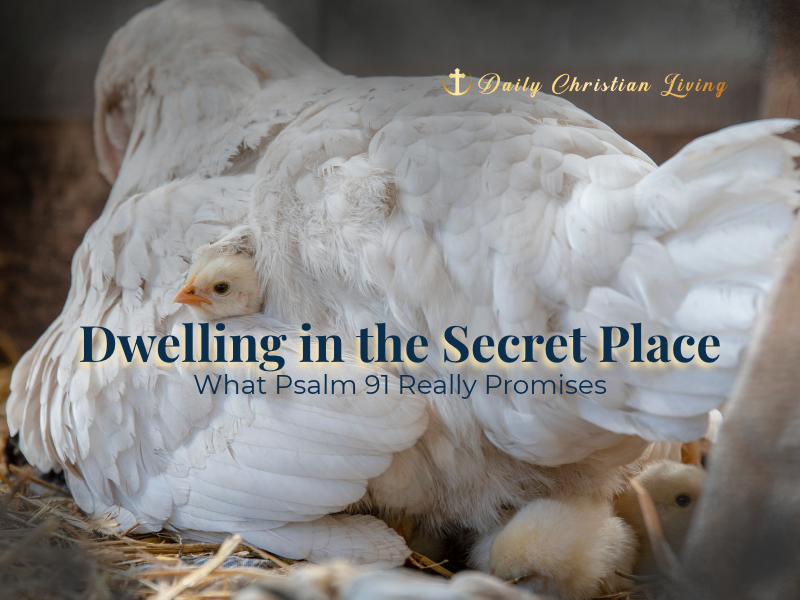
The picture of God’s wings in Psalm 91 describes close, tender protection, the way a mother bird covers her young when danger comes. It speaks of nearness just as much as it speaks of safety. After all, nobody can hide under a wing from across the field.
Psalm 91:4 — “He shall cover thee with his feathers, and under his wings shalt thou trust: his truth shall be thy shield and buckler.”
Anybody who has grown up around a farm has seen it. When a hawk circles overhead, the hen doesn’t fight the hawk. She spreads her wings, the chicks run underneath, and she sits down on top of them. The hawk would have to go through her to get to them.
- Ruth found shelter there. When Boaz first met Ruth, a Moabite widow gleaning in his field, he blessed her as one “under whose wings thou art come to trust” (Ruth 2:12). She was an outsider who came in close, and God covered her.
- Jesus used the same picture. Looking out over Jerusalem, He grieved, “how often would I have gathered thy children together, even as a hen gathereth her chickens under her wings, and ye would not!” (Matthew 23:37). The shelter was offered, but they wouldn’t come.
- His truth is the shield. The end of verse 4 tells us how God guards His people: through His truth. A “buckler” was a small round shield for close fighting. God’s Word protects the dweller in the hand-to-hand battles of life.
That last point matters more than it might seem, because the very next time Psalm 91 shows up in the Bible, someone tries to turn God’s truth into a weapon against Him.
The Devil Quoted Psalm 91 Too
When Satan tempted Jesus on the pinnacle of the temple, he quoted Psalm 91:11–12 almost word for word and dared Jesus to jump. Jesus refused. Psalm 91 was never meant to be a dare for testing God, and the Lord Himself showed us how to read it.
Matthew 4:5–6 — “Then the devil taketh him up into the holy city, and setteth him on a pinnacle of the temple, And saith unto him, If thou be the Son of God, cast thyself down: for it is written, He shall give his angels charge concerning thee: and in their hands they shall bear thee up, lest at any time thou dash thy foot against a stone.”
Think about that for a minute. The devil can quote Scripture. He knew Psalm 91 well enough to recite it from memory, and he used it to try to get the Son of God to do something foolish. But look closely at what he did with it.
- He left out a phrase. Psalm 91:11 says God’s angels have charge over thee “to keep thee in all thy ways.” Satan skipped right over those words. God’s protection covers the paths He sends us down, not the stunts we dream up to make Him prove Himself.
- He stopped before verse 13. The very next verse says, “the young lion and the dragon shalt thou trample under feet.” Satan didn’t care to read the part about the serpent being crushed.
- Jesus answered with Scripture. “Jesus said unto him, It is written again, Thou shalt not tempt the Lord thy God” (Matthew 4:7). He didn’t argue with Psalm 91. He set it beside Deuteronomy 6:16 and let Scripture interpret Scripture.
It’s worth noticing, too, that Satan’s temptation came right after Jesus had refused to turn stones into bread. The devil had been answered with Scripture once, so he came back with Scripture of his own. That’s still how he works. He rarely tells a believer to throw the Bible away. He’s much more likely to hand us a verse pulled out of its setting and let us run with it.
So here’s the lesson. Any reading of Psalm 91 that pushes us to put God to the test, to take foolish risks, or to demand that He perform on our schedule is the devil’s reading of the psalm. The Lord’s reading leads to trust.
Does Psalm 91 Mean Christians Will Never Get Sick or Hurt?
No. Psalm 91 promises God’s presence, His protection, and His final deliverance, but Scripture is full of faithful believers who suffered, got sick, and died. In fact, verse 15 says, “I will be with him in trouble,” which takes for granted that trouble will come.
This is where many of us get stuck. We’ve prayed Psalm 91 over a sick loved one. We’ve claimed every verse and believed every word, and then we stood at the graveside anyway. We read “There shall no evil befall thee, neither shall any plague come nigh thy dwelling” (Psalm 91:10), and we wonder, “Was I doing it wrong? Did I not have enough faith?” That’s an honest question, and it’s worth sitting with rather than rushing past.
Well, the first thing to say is that the Bible itself doesn’t read Psalm 91 that way. Hebrews 11 lists the great heroes of faith, and right alongside the ones who escaped the sword are the ones who didn’t:
Hebrews 11:37, 39 — “They were stoned, they were sawn asunder, were tempted, were slain with the sword… And these all, having obtained a good report through faith, received not the promise.”
Those believers didn’t fail at faith. God commended them for it.
The same was true of Paul himself. He prayed three times for God to take away his thorn in the flesh, and God said no. But the Lord didn’t leave him empty-handed: “My grace is sufficient for thee: for my strength is made perfect in weakness” (2 Corinthians 12:9). Paul didn’t get the healing he asked for. He got the presence of Christ resting on him in the middle of it, and by the end of that chapter he was glad for the weakness.
By the end of his life, Paul understood the difference between escaping trouble and being kept by God in it. Sitting in a Roman prison with his execution coming, he wrote:
2 Timothy 4:18 — “And the Lord shall deliver me from every evil work, and will preserve me unto his heavenly kingdom: to whom be glory for ever and ever. Amen.”
Paul wasn’t expecting to walk out of that cell. He was expecting to walk into heaven. And he called that deliverance.
So what does Psalm 91 promise? It promises that no evil can reach the soul of the one who dwells with God, and that nothing in all creation can pull him out from under those wings. “Who shall separate us from the love of Christ? shall tribulation, or distress, or persecution, or famine, or nakedness, or peril, or sword?” (Romans 8:35). Sometimes God delivers us from the trouble. Sometimes He carries us through it. And for every believer, there’s a day when He delivers us out of this world altogether and into His presence. All three are deliverance.
Two Ways to Miss This Psalm
Some Christians treat Psalm 91 like a lucky charm, as if reciting it guarantees nothing bad will ever happen. Others have been hurt and decided it’s just pretty poetry with no real promise in it. Both errors miss what God actually says.
Error one: the magic shield. There’s a popular kind of “Psalm 91 protection” teaching that turns this chapter into an incantation. Pray it every morning, claim it over your house and your car, and nothing can touch you. And if something does touch you, well, you must not have believed hard enough. That’s name-it-and-claim-it theology, and it does real damage. It heaps guilt on suffering saints who already have enough to carry. And as we’ve seen, it’s the devil’s way of reading the psalm, not the Lord’s.
Error two: the cynic. On the other side are believers who got hurt, prayed and didn’t see the answer they wanted, and quietly decided God doesn’t really protect anybody. But Scripture is plain about God’s care for His own:
Psalm 34:7 — “The angel of the LORD encampeth round about them that fear him, and delivereth them.”
Hebrews 1:14 calls the angels “ministering spirits, sent forth to minister for them who shall be heirs of salvation.” Actually, most of God’s protection happens where we never see it. We’ll probably find out in heaven how many accidents we never had and how many dangers passed us by on a Tuesday afternoon without our ever knowing.
That said, God isn’t offended when a frightened child of His holds Psalm 91 tight in the middle of a storm. He invites it. He just wants us holding onto Him, not onto the words as though they had power apart from Him.
How Do We Make God Our Dwelling Place?
We make God our dwelling place by meeting with Him daily, speaking our trust out loud, setting our love on Him, learning His name, calling on Him, and walking in His ways. The last three verses of Psalm 91 spell out the marks of the person God promises to deliver.
Here are some practical ways to move from visiting to dwelling:
- Go in every day, not just in the storm. Dwelling is a habit. Open the Word and pray before the sirens sound, so the way down to the cellar is familiar when you need it.
- Say it out loud. “I will say of the LORD, He is my refuge” (Psalm 91:2). Speak your trust as a testimony, to God and to the people around you.
- Set your love on Him. “Because he hath set his love upon me, therefore will I deliver him” (Psalm 91:14). The promise is tied to affection, not just information.
- Learn His name. “I will set him on high, because he hath known my name” (Psalm 91:14). Get to know who God is from His Word; “The name of the LORD is a strong tower: the righteous runneth into it, and is safe” (Proverbs 18:10).
- Call on Him. “He shall call upon me, and I will answer him” (Psalm 91:15). Don’t wait until you’ve tried everything else.
- Stay in His ways. The angels of verse 11 keep us “in all thy ways.” The safest place to be is right where God told you to go.
“I Will Shew Him My Salvation”
Psalm 91 ends with God’s greatest promise: He will show His salvation to the one who trusts Him. All the shelter in this psalm starts there, because the only truly safe place for a sinner is in Christ.
Psalm 91:16 — “With long life will I satisfy him, and shew him my salvation.”
The Hebrew word for “salvation” there is yeshuah, and it comes from the same root as the name Jesus. The psalm that opens with a secret place ends by pointing straight to the Savior. And the long life it promises finds its fullest meaning in Him: “I give unto them eternal life; and they shall never perish, neither shall any man pluck them out of my hand” (John 10:28).
If you’ve never trusted Christ, you’re standing outside in the storm, and the door is open.
Romans 10:9 — “That if thou shalt confess with thy mouth the Lord Jesus, and shalt believe in thine heart that God hath raised him from the dead, thou shalt be saved.”
The promise is for anyone: “For whosoever shall call upon the name of the Lord shall be saved” (Romans 10:13). Our Secure Salvation page walks through it step by step.
Father, thank You for being our refuge and our fortress. Forgive us for the times we’ve only run to You when the storm was already on top of us. Teach us to dwell with You every day, to trust You when You deliver us from trouble and when You carry us through it. Keep us close under Your wings, and let us rest in the salvation You’ve shown us in Your Son. In Jesus’ name, amen.
No responses yet