
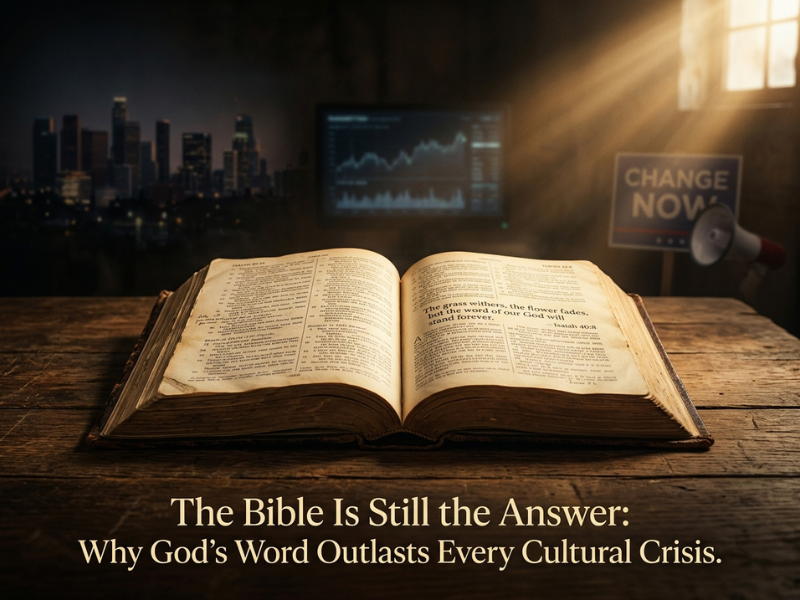
Key takeaways: The Bible is still the answer because it is God-breathed (2 Timothy 3:16) — profitable for doctrine, reproof, correction, and instruction in righteousness. It has outlasted every cultural crisis because the Word of God stands forever (Isaiah 40:8). Recovery begins when we put it back at the center: read it daily, believe it fully, and obey it completely.
Somewhere out in every county there is an iron rod driven into the ground, and almost nobody knows where it is. Surveyors call it a monument. Every property line for miles traces back to that one point.
Now, the trouble is that fences move. A man builds a shed a few feet over the line, and nobody says anything. The next owner assumes the shed marks the corner and runs his fence off it. Twenty years go by, the old-timers die off, and two neighbors are arguing about eight feet of grass.
Well, that argument does not end with a better opinion or a louder voice. It ends when somebody hires a surveyor, and the surveyor goes out and finds the rod.
Proverbs 22:28 — “Remove not the ancient landmark, which thy fathers have set.”
That is where this country is, and where a good many Christian homes are too. Everybody argues about where the line goes, and nobody wants to dig up the marker. The marker has not moved an inch.
Why Do We Say the Bible Is Still the Answer?
Because God has not issued a revision. Scripture claims to be God’s own words breathed out through men, and it claims to be sufficient; enough to equip a believer for every good work God will ever ask of him. If that claim is true, no cultural shift can date it.
2 Timothy 3:16-17 — “All scripture is given by inspiration of God, and is profitable for doctrine, for reproof, for correction, for instruction in righteousness: That the man of God may be perfect, throughly furnished unto all good works.”
“Given by inspiration of God” is one Greek word, theopneustos; God-breathed, exhaled. And “throughly furnished” is exartizō, the word for outfitting a ship before a voyage: rope, canvas, charts, every item on the manifest loaded. Nothing was forgotten when that ship cleared the harbor. Peter says the same, God’s divine power hath given unto us all things that pertain unto life and godliness (2 Peter 1:3).
Now, sufficiency gets heard as something it never meant.
- It is not a manual for everything. It will not teach you to rewire a house or read a balance sheet, and never claimed it would.
- It is enough for faith and practice. Every question of what is true, what is right, and how a man ought to live falls inside its jurisdiction.
- Nothing needs to be added to it. Not a new revelation, not a new movement, not the latest expert consensus. Proverbs 30:6: add thou not unto his words.
How Can a Book This Old Answer Problems It Never Names?
Through principle. Scripture governs by direct command where it speaks to a matter by name, and by settled principle everywhere else. It never mentions your job offer or the diagnosis you got last month, and it still has everything to say about both.
Many of us read “thoroughly furnished unto all good works” and think, well, that sounds fine, but my problem is not in there. There is no chapter on the job offer, and no verse with my daughter’s name in it. That objection deserves better than a pious brush-off.
Here is a small example. As a man gets older, his memories fade, and I found myself wondering what the point is in making memories at all if most of them will be gone eventually anyway.
There is no chapter in Scripture called On the Fading of Memory. But there is Ecclesiastes 5:20, “a man shall not much remember the days of his life, because God answereth him in the joy of his heart.” Working through that verse recently moved the question onto different ground. The joy God gives a believer now, and the eternity on the far side of it, outweigh the memories we hold to so tightly.
Psalm 119:105 — “Thy word is a lamp unto my feet, and a light unto my path.”
A lamp does not light up the county. It shows a man where the next step goes. Isaiah gives the test in a line: to the law and to the testimony: if they speak not according to this word, it is because there is no light in them (Isaiah 8:20).
What Happened When America Moved Its Standard?
The Book came out of the center of American life a piece at a time, and the bill arrived on a delay. Scripture was once the shared standard even among people who never believed it. That common ground is gone, and our arguments now are what is left when the marker goes missing.
American children once learned their letters out of Scripture, and John Adams called the Bible the “most republican book in the world.” The New England Primer taught the alphabet with rhymed couplets drawn from the Bible before moving on to catechism and the Lord’s Prayer.
Webster’s blue-backed speller, which taught five generations to read, carried the same material, and he himself was not converted until he was forty-nine. McGuffey’s Readers carried it into the next century. And Timothy Dwight, facing a Yale student body gone skeptical, put the Bible on the table and invited their best objections. Revival followed.
Now, that arrangement came apart in about two years. Engel v. Vitale in 1962 ended school-sponsored prayer, and Abington School District v. Schempp in 1963 ended school-sponsored Bible reading. The Book came out of the room, and the effects showed up over sixty years rather than the next semester.
In my lifetime, I have certainly noticed this gradual decline.
Growing up, there was a general respect for the things of God even among people who never came to church. The neighbor who slept in on Sunday still dressed decently and took his hat off at a funeral, and still understood that a society built on biblical principles was a better place to raise children.
Today, outside the church walls, that understanding is mostly gone. We are now essentially living in the time of Judges:
Judges 21:25 — “In those days there was no king in Israel: every man did that which was right in his own eyes.”
Amos, describing judgment on a nation, predicts a famine of hearing the words of the LORD (Amos 8:11-12). Hosea says God’s people are destroyed for lack of knowledge (Hosea 4:6). Not lack of sincerity. Lack of knowledge.
Has a Nation Ever Recovered God’s Word After Losing It?
Yes, and more than once. The clearest case is Judah under King Josiah, where the Scriptures were not destroyed by an invading army. They were lost inside the temple by the men paid to keep them. When the book was found and read aloud, national reformation followed.
Josiah came to the throne at eight, and by his 18th year he had ordered the temple repaired. In the middle of that work, Hilkiah the priest found something in the rubble.
2 Kings 22:8 — “And Hilkiah the high priest said unto Shaphan the scribe, I have found the book of the law in the house of the LORD.”
Sit with where they found it. Not in a foreign palace or buried in a field, but in the house of the LORD, in a building staffed by men whose whole occupation was the worship of God. Nobody burned it. They stopped reading it, and after a generation nobody noticed it was gone.
Shaphan read it to the king, and Josiah rent his clothes. He had a reform program running already and no idea how far the nation had drifted, because he was working without the standard. What follows in 2 Kings 23 is the most thorough housecleaning in Judah’s history.
Ezra did the same after the exile, reading the law from morning until midday while the people gave attendance for hours (Nehemiah 8:3). Of course revival has never once started with a fresh idea. It starts when somebody reads the Book out loud.
Isn’t the Bible Just an Old Book Written by Flawed Men?
It was written by flawed men, but that is not the whole story. Scripture claims those men were carried along by the Holy Ghost as they wrote, so that the product is God’s word and not theirs. That claim has been examined more thoroughly than any book in history.
The objections come in a few standard shapes. We have advanced past all that. It was written by men, so it carries their errors. How would anybody know it is true?
2 Peter 1:21 — “For the prophecy came not in old time by the will of man: but holy men of God spake as they were moved by the Holy Ghost.”
Peter grants the men. Moses wrote, Isaiah wrote, Luke did research. What he denies is that the will of man was the origin. The word rendered “moved” is used of a ship under wind: the sailors work, and the wind decides where she goes.
And “how do we know it is true” has real answers; manuscript evidence, archaeology confirming details critics wrote off as invented, and prophecy recorded centuries ahead of fulfillment. Lee Strobel’s works are a good place to start, an atheist journalist who set out to disprove the resurrection and came out a Christian.
But the argument your neighbor is most likely to be moved by is not on a bookshelf. It is watching the thing work in a life. Hebrews 4:12 calls the “Word quick, and powerful, and sharper than any two-edged sword.”
Where Do Bible-Believing Christians Get This Wrong?
Two ways, and they run in opposite directions. Some of us substitute talk about the Bible for the Bible itself, filling our ears while the Book stays closed. Others know the text cold and never let it change anything. Both leave a believer unarmed.
Take the first one. There is more Christian content now than any generation before us could have imagined, and early on I took in a great deal of it; radio on the drive to work, a service on television, book after book.
And the more Scripture I actually learned, the more of what came from the extra-biblical sources fell apart. Not because the men were frauds necessarily, but because a fair amount of it simply was not in the Bible, and some contradicted the Book outright. These days, I read little outside of Scripture and stay connected to the teachings of my local church, which I know are grounded in the Bible.
2 Timothy 4:3 — “For the time will come when they will not endure sound doctrine; but after their own lusts shall they heap to themselves teachers, having itching ears.”
Paul does not describe people abandoning teaching. He describes people heaping it up and selecting by appetite. A man can be well fed and badly malnourished. That said, there is a ditch on the other side of the road, and the Lord Jesus said this to the Pharisees, men who knew the Scriptures cold:
John 5:39 — “Search the scriptures; for in them ye think ye have eternal life: and they are they which testify of me.”
They searched daily and could recite whole books of it. And the One the entire library was written about stood in front of them, and they walked right around Him. James says a man who hears the Word and does not do it is like a man who looks in a mirror and forgets what he saw (James 1:23-24).
How Do We Put the Bible Back at the Center This Week?
By treating it as intake rather than decoration. That means reading enough at one sitting to get the context, protecting the time before the day gets loud, putting the Book back into the household, and coming to it willing to be corrected instead of confirmed.
So here is where all of this lands for me on a typical Tuesday:
- Read a full chapter at a minimum. A verse pulled off a calendar has the context stripped off it. I read at least one whole chapter in a sitting, usually more, because the chapter is where you find out who is talking and what came before.
- Get the big picture early, then go deep. I have read the Bible cover to cover in a year twice, both times early in my Christian life, and I would do it the same way again. It gave me the shape of the whole thing, and after that the reading slowed, and the depth came. Plenty of good men keep a yearly plan for life and swear by it, so I’m not saying my way is the only way.
- Anchor it to the morning. My reading has never stopped since I was saved, but it thins out in the busy stretches, and always the same way. It slides to the end of the day, where it dies. The Lord Jesus rose up a great while before day to pray (Mark 1:35).
- Put it back in the house. My mother read her Bible every day and taught her children to do the same, and that is still the practice in our home. We are encouraging our daughter toward it with her own family. Deuteronomy 6:7 tells parents to talk of these words sitting in the house and walking by the way — a household where the Book is normal.
- Read to be corrected, not confirmed. Back in college I was convinced a saved person could lose their salvation, and I set out to write a paper proving it. I went to Scripture to win an argument and found I had it backwards — the moment a man trusts Christ, he is adopted into the family of God (Romans 8:15), and adoption does not get undone. The Bereans checked the preacher against the Book (Acts 17:11), and the Holy Ghost calls them noble for it.
Have You Been Born Again by That Word?
All of this assumes something. A man can respect the Bible, defend it in an argument, and want it back in the schools, and still be lost. The Book that outlasts nations is the Book God uses to save a soul, and Peter says so without hedging.
1 Peter 1:23 — “Being born again, not of corruptible seed, but of incorruptible, by the word of God, which liveth and abideth for ever.”
All have sinned and come short of the glory of God (Romans 3:23). Christ died for our sins, was buried, and rose again the third day (1 Corinthians 15:3-4). The promise has no fine print on it:
Romans 10:9 — “That if thou shalt confess with thy mouth the Lord Jesus, and shalt believe in thine heart that God hath raised him from the dead, thou shalt be saved.”
Admit you are a sinner. Believe He died and rose again for you. Call on Him today and get it settled.
Where Does That Leave Us?

Standing over the same marker our fathers stood over, free to dig it up any morning we decide to. Two neighbors can argue about eight feet of grass for twenty years, and the rod is in the ground the whole time. The standard is right where God put it, available to any man, any household, and any church that wants it.
That is the good news underneath all the bad news about our culture. Nothing that happened in 1962 or 1963 touched the Word of God, and nothing since has outvoted it. It has answered every generation that opened it, and it will answer ours.
Jeremiah 6:16 — “Thus saith the LORD, Stand ye in the ways, and see, and ask for the old paths, where is the good way, and walk therein, and ye shall find rest for your souls.”
The grass withereth, the flower fadeth: but the word of our God shall stand for ever (Isaiah 40:8). It stood before this nation and it will stand long after. Open it tomorrow morning and start there.
Father, thank You for giving us Your Word and for keeping it through every generation that tried to set it aside. Forgive us for the mornings we have left it closed and for looking everywhere but Your Book for answers. Give us hunger for it, honesty enough to be corrected by it, and courage to live by it. Use it to save the lost and steady Your people. In Jesus’ name, amen.
Comments are closed