
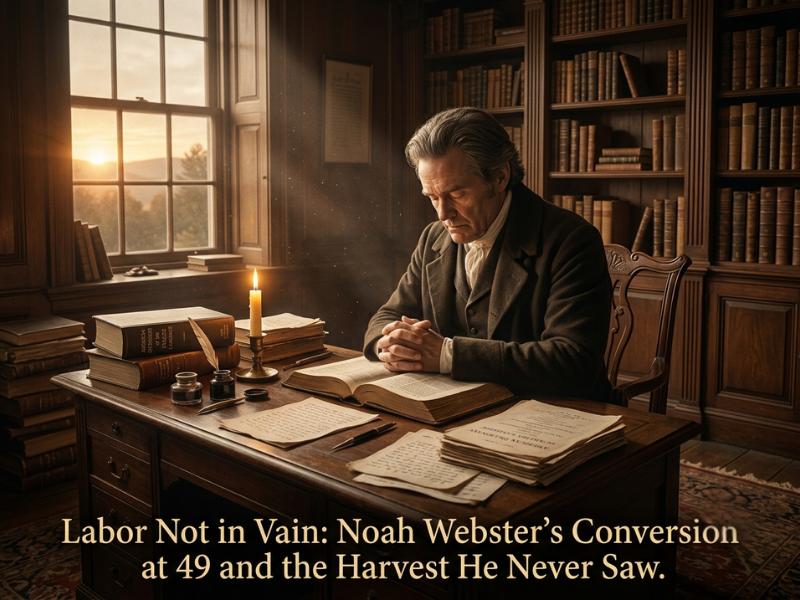
Goshen, New York, winter of 1782. The American army was camped along the Hudson, the war was not finished, and in a two-room brick schoolhouse a twenty-three-year-old teacher stood listening to his students read.
The book in their hands had been printed in England. Thomas Dilworth’s New Guide to the English Tongue was the standard primer on both sides of the Atlantic — which meant American children, in a country fighting for its life, were learning their letters out of a British schoolbook. The schoolmaster thought it defective from the ground up, and said so.
So he wrote a better one.
Now, that is the kind of story we like to tell. A young man sees a problem, rolls up his sleeves, and fixes it. Within a year, the blue-backed speller was in print, and it taught five generations of American children how to read. Noah Webster hauled copies town to town in his saddlebags. At least one contemporary called him an incurable lunatic. He kept going anyway.
But there is a part that never made it onto the historical marker outside the Goshen town hall. For the first half of that career, Noah Webster was lost.
He was in church. He was sober, industrious, and about as respectable as a man could be in New Haven. He argued in print that a nation needed men in office who feared God. And he was not saved.
Well, God got him at forty-nine, and everything he had built changed hands that April.
Then, at seventy, he published it. And it failed. He mortgaged his house to keep it alive, sank into debt he never escaped, and died with the unsold volumes stacked around him, believing twenty years of labor had come to nothing.
Scripture has a word for a life like that, and it lands at the tail end of the greatest resurrection chapter in the Bible.
1 Corinthians 15:58 — “Therefore, my beloved brethren, be ye stedfast, unmoveable, always abounding in the work of the Lord, forasmuch as ye know that your labour is not in vain in the Lord.”
Why Did a Respectable Church Member Need to Be Born Again?
Because morality is not regeneration. Webster attended the meeting house, kept his word, paid his debts, and defended religion publicly — and none of it saved him. The Lord Jesus told a religious ruler he must be born again, and said it to the most respectable man in Jerusalem.
In 1807 revival came to the First Congregational Church of New Haven, where Moses Stuart was pastor. Webster wanted no part of it. He worried that stirred-up feelings would be mistaken for real religion, and he pressed a rational faith on his family.
His wife went anyway, and his two oldest daughters went with her. They were among the first brought under conviction. Webster did not forbid it outright, but he made his displeasure known — and then watched his own children come to Christ in front of him.
Actually, that is a mercy worth pausing over. God sent the gospel into that home through the people Webster loved most and could not argue with. By April of 1808 he had given up the argument. In a letter that December he described it as a sudden impulse of repentance and an entire surrender of himself to his Maker and Redeemer.
Webster was not a drunkard in a ditch. He was the man sitting three rows behind you on Sunday morning.
- He had religion without the new birth. He believed in God and defended the faith publicly, but never once came to Christ as a guilty sinner needing a Saviour.
- He had reason where he needed repentance. A rational religion can be held at arm’s length. Repentance requires a man to come down off his dignity and admit he is lost.
- He had a good name and a lost soul. Reputation is a poor substitute for righteousness and will not stand at the judgment.
The Lord Jesus settled this with Nicodemus, a ruler of the Jews, and did not soften it:
John 3:7 — “Marvel not that I said unto thee, Ye must be born again.”
Church attendance is a good habit. It has never saved anybody.
Is It Ever Too Late to Come to Christ?
No. As long as a man is breathing, the offer stands. The Lord Jesus told of a householder who kept hiring laborers all day — and the men hired at the eleventh hour received the same wage as the men who started at dawn.
In Matthew 20 the householder goes out at the third hour, and again at the sixth and ninth, and at the eleventh hour he finds men still standing idle. He sends them in with an hour of daylight left, and when the reckoning comes he pays them a penny — the same penny the sunrise crew got.
Of course the early workers complained, and the Lord let them, so we could hear His answer. The householder had wronged no one; he had been generous with what was his. Then comes the question that ought to end the argument:
Matthew 20:15 — “Is it not lawful for me to do what I will with mine own? Is thine eye evil, because I am good?”
Webster was hired at the eleventh hour. So was the thief on the cross, who had nothing to offer but a dying confession and heard back, “To day shalt thou be with me in paradise” (Luke 23:43). Neither earned the penny. Neither do we.
- You have not run out the clock. Fifty, sixty, seventy — the vineyard is still hiring, and the wage is not reduced for latecomers.
- Wasted years do not disqualify you. Webster gave God the second half of his life, and God used it more than the first.
- The penny is grace, not payment. Nobody in that parable got what he was worth. Every man got what the householder decided to give.
What Changed When Webster’s Work Became God’s Work?
The work itself did not change — the ownership did. Webster had already begun his great dictionary in 1807, the year before his conversion. He finished it as a Christian man. Same desk, same volumes, same twenty-six languages of etymology, and an entirely different Master over the whole enterprise.
This is easy to skip past. He started the dictionary lost and finished it saved. The project did not get swapped out for something more spiritual; he did not abandon lexicography for the ministry. He went back to the same table the next morning and kept tracing words through language after language.
Now, that ought to settle something for a lot of believers. There is a persistent notion that when God saves a man He must be calling him out of his trade and into full-time ministry, and that anything less is second-tier service. Webster spent twenty more years on a dictionary, and the Lord was pleased to have him there.
What changed was the aim. Definitions began carrying Scripture in them, and the book that came out the far side of those twenty years was a work of reference and a testimony at once. It was published in 1828, when Webster was seventy, and priced at fifteen to twenty dollars in a country where that was an extravagant sum.
What Does “Labour Is Not in Vain in the Lord” Actually Mean?
It means the value of your work is fixed by whom it is done for, not by what it produces. Paul does not promise we will see results. He promises that work done in the Lord is never hollow and never comes to nothing, whatever the ledger says at the end.
Two words in that verse do the heavy lifting.
The word for “labour” is kopos, and it does not mean pleasant effort. It is the kind of toil that wears a man out — weariness, the ache at the end of a long day. Paul is not talking about the light stuff, but about work that costs you.
And “in vain” is kenos — empty, hollow, a jar with nothing in it. The promise is not that your labor will be comfortable or admired or successful. The promise is that it will not be empty.
Well, many of us read that verse and think, all right, but Webster died believing his life’s work had come to nothing. He was not being dramatic — the volumes sat unsold, and the debt was real. Where exactly is the not-in-vain in that? It is a fair question, and Scripture does not dodge it.
The answer sits in the last three words: in the Lord. Paul does not say your labor will be rewarded on schedule, or that it will bear fruit you can count. He says labor offered up to Christ lands in His hands and is kept there, whether or not the man who did it ever gets a report.
What Happens When We Never See the Fruit of Our Labor?
Then we die in faith, like the men of Hebrews 11, seeing the promises from a distance and being persuaded of them anyway. God is not obligated to show us the harvest in our lifetime. He is obligated to keep His word — and He always does, often on a timetable that outlives us.
Noah Webster died on the twenty-eighth of May, 1843, at eighty-four, leaving behind a stack of unsold dictionaries and the debts that came with them. As far as he could tell on his last day, the labor of his life had been a commercial failure.
Within months, two printer brothers in Springfield, Massachusetts — George and Charles Merriam — bought the unsold copies and the revision rights from his estate. They did the one thing Webster never could: they brought the price down. Their 1847 edition sold for six dollars and moved immediately. Massachusetts ordered a copy for every school in the state.
By now the name sits on a shelf in nearly every home and classroom in America. Webster never knew. He had been in the ground four years before any of it happened.
Hebrews 11:13 — “These all died in faith, not having received the promises, but having seen them afar off, and were persuaded of them, and embraced them, and confessed that they were strangers and pilgrims on the earth.”
That verse summarizes a whole chapter of people who never got to see it. Moses died on Nebo looking across at a land he was not permitted to enter. And the Holy Ghost does not record one of them as a failure.
- Faithfulness is measured at the desk, not at the finish line. Webster’s obedience was complete the day he died. The success came later and added nothing to it.
- God’s timeline is longer than ours. Four years, forty years, four generations — He is not accountable to our calendars.
- You may be planting for someone else’s harvest. The prayers you pray now may be answered in a grandchild you never meet.
Doesn’t Faithfulness Usually Produce Visible Results?
Sometimes it does, and we thank God for it. But there is a strain of teaching that treats visible results as proof of God’s approval, and Scripture flatly contradicts it. Some of the most faithful men in the Bible labored for decades with almost nothing to show for it.
This needs saying plainly, because it is taught the other way from a great many platforms right now. If the church is not growing, something must be wrong with the man in the pulpit. If your obedience has not produced a breakthrough, you must be missing a key — more faith, more positive confession, more of whatever the latest book is selling.
Now take that standard back to the prophets. Jeremiah preached for forty years and watched the nation go into captivity anyway. Noah preached while he built, for a very long time, and eight souls went into the ark. By any metric a modern conference would recognize, every one of those men failed.
That said, this cuts both ways, and it would be dishonest to leave it there. Fruitlessness is not automatically a badge of faithfulness. Sometimes a ministry is barren because it quit preaching the Word, or because sin is tolerated, or because the man in charge grew lazy and calls it patience. We are still commanded to plant and water; what we may not do is take credit for the increase or panic when we cannot see it.
1 Corinthians 3:6 — “I have planted, Apollos watered; but God gave the increase.”
How Do We Work “As to the Lord” This Week?
By deciding in advance who the audience is. Colossians 3:23 puts the whole Christian work ethic under one heading: do it heartily, as to the Lord. That settles whether anyone notices, whether the numbers move, and whether you ever see what came of it.
Colossians 3:23-24 — “And whatsoever ye do, do it heartily, as to the Lord, and not unto men; Knowing that of the Lord ye shall receive the reward of the inheritance: for ye serve the Lord Christ.”
So here is where this lands on a Monday morning.
- The job nobody is watching. Do it heartily. The Lord Christ is the one you serve, and He needs no supervisor’s report to know what you did.
- The class of four. Teach it like there are four hundred. Webster’s life work started in a two-room schoolhouse in a town nobody had heard of.
- The child you have prayed for twenty years. Keep praying. Webster’s daughters got saved before he did, and God used them to reach their own father.
- The work you will not live to see finished. Finish your part of it. Somebody else will be handed the rest, and God has already arranged for that.
Have You Come to Christ Yourself?
All of this assumes you are His. If you are where Webster was at forty-eight — respectable, religious, and lost — nothing else you do will count for eternity. That is the first thing to settle, and it can be settled today.
You are a sinner, and so am I; all have sinned and come short of the glory of God (Romans 3:23), and the wages of that sin is death (Romans 6:23). But Christ died for our sins, was buried, and rose again the third day (1 Corinthians 15:3-4).
Romans 10:13 — “For whosoever shall call upon the name of the Lord shall be saved.”
Whosoever. Call on Him — admit you are a sinner, believe He died and rose for you, and receive Him as your Saviour. Webster had thirty-five years after that April; you may not have thirty-five days, and now is the accepted time (2 Corinthians 6:2).
Father, thank You that the vineyard is still hiring and that no one who comes to You is turned away for coming late. Forgive us for measuring our work by what we can see and for losing heart when the harvest does not come on our schedule. Help us to labor heartily, as unto You, in the ordinary places You have put us, and to leave the increase in Your hands where it has always belonged. And for the one reading this who has been religious but never born again, open his eyes today. In Jesus’ name, amen.
Comments are closed