
Key takeaways: Ecclesiastes 3:8 declares there is “a time of war, and a time of peace” — and Peter Muhlenberg’s January 21, 1776 farewell sermon proved that discerning God’s season and obeying at personal cost is the mark of genuine faith. Scripture teaches that God appoints every season (Ecclesiastes 3:1), that wisdom discerns both time and judgment (Ecclesiastes 8:5), and that faith without works is dead (James 2:17). You can obey in your own season today — settle the surrender question in advance, be faithful in small things, count the cost honestly, and act when God makes the season plain.It was Sunday morning, January 21, 1776, and the pews of a small Lutheran church in Woodstock, Virginia, were
full. A cold wind rattled the shutters. Farm families sat sho
ulder to shoulder in their winter wool, children wedged between parents, waiting on the pastor they trusted — the man who had baptized their babies and buried their dead.
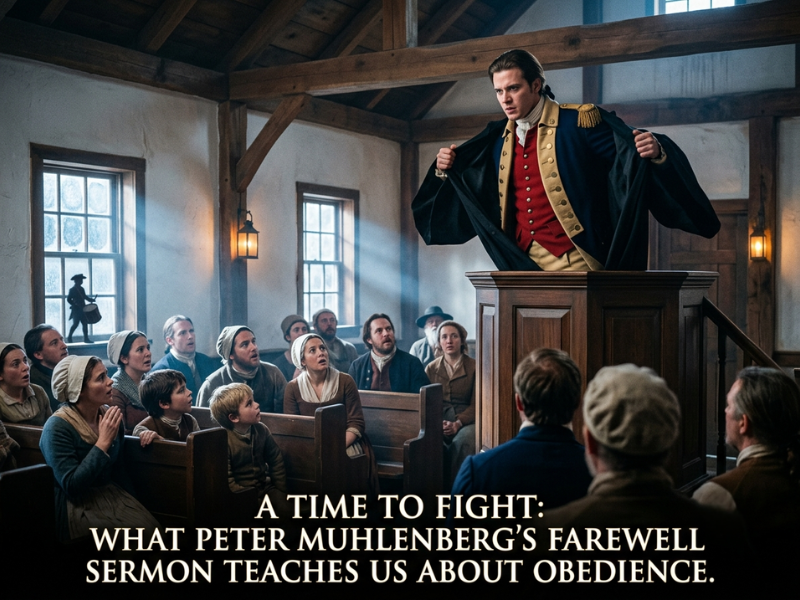
The Reverend Peter Muhlenberg climbed into the pulpit in the long black robes of his office, opened his Bible to Ecclesiastes 3, and began to read aloud. A time to be born, and a time to die. He read slowly, letting each contrast land, and when he reached the eighth verse — a time of war, and a time of peace — he stopped and looked out over his people.
“In the language of the text,” he said, “there is a time for all things — a time to preach and a time to pray. But there is also a time to fight, and that time has now come.”
Then, in front of his stunned congregation, he reached up and tore off his robes. Underneath them he wore the uniform of a colonel in the Continental Army. Outside the church, a drum began to beat.
The old accounts say three hundred men enlisted that day; the muster rolls suggest closer to a hundred and sixty. Either way, by sundown a congregation had become the heart of the Eighth Virginia Regiment, and their pastor was its commanding officer.
Now, most of us will never be asked to trade a robe for a uniform, and thank God for that. But every believer who walks with the Lord long enough will face a morning like that one — a morning when the season changes and obedience suddenly gets expensive.
Who Was Peter Muhlenberg?
Peter Muhlenberg (1746–1807) was a Lutheran pastor in Virginia’s Shenandoah Valley who left his pulpit in 1776 to raise the Eighth Virginia Regiment at George Washington’s personal request. He fought from Brandywine to Yorktown, rose to the rank of major general, and later served in both houses of Congress.
He was not an obvious candidate for any of it. Peter was born in Trappe, Pennsylvania, the eldest son of Heinrich Melchior Muhlenberg, the man historians call the patriarch of American Lutheranism. His father expected him to enter the ministry; Peter had other ideas. Bright but restless, he was shipped off to Germany at seventeen for theological training and promptly got himself expelled. He was apprenticed to a grocer, ran off, and enlisted with a German cavalry regiment instead. His comrades gave him a nickname: Teufel Piet. Devil Pete.
Well, God has a long track record with runaways. By 1767 Peter was back in Pennsylvania and, to everyone’s surprise, preparing for the ministry after all. He was ordained and accepted a call to the frontier settlement of Woodstock, deep in Virginia’s Shenandoah Valley.
By 1775, the cause of American liberty had become personal. Muhlenberg chaired his county’s Committee of Safety and corresponded with Patrick Henry — and with a Virginia planter named George Washington. Washington had a problem: the new Continental Army needed officers the frontier settlers would actually follow, and in the Shenandoah, the most trusted man for miles was the pastor at Woodstock. So Washington wrote to him personally and asked him to raise a regiment.
Muhlenberg did not answer overnight. He spent weeks in prayer and in Scripture. His father begged him not to take up arms; his older brother Frederick, a pastor himself, opposed the idea too. But by the time that January Sunday arrived, Peter had settled the matter before God. The congregation he had baptized, married, and buried was now the congregation he was called to defend.
What Does Ecclesiastes 3 Teach About God’s Timing?
Ecclesiastes 3 teaches that God appoints the seasons of life — we do not choose them, schedule them, or skip them. Our responsibility is to discern which season we are in and then to obey God inside it, because the same God who appoints the pleasant seasons also appoints the costly ones.
Solomon opens the chapter with one of the most familiar sentences in all of Scripture:
Ecclesiastes 3:1 — “To every thing there is a season, and a time to every purpose under the heaven:”
The Hebrew is worth a moment here. The word translated “season” is zeman, a fixed, appointed occasion — not a mood, and not a phase we drift through. The word for “time” is eth, the fitting moment for a particular thing. So the verse is not shrugging at the randomness of life; it is declaring that God sets the calendar. Fourteen pairs follow, and at the tail end of the list sits the pair no congregation ever expects to hear applied to itself: “a time of war, and a time of peace” (Ecclesiastes 3:8).
Of course, we all like some seasons better than others. Nobody prays for a time to weep, and no church files into the pews hoping for a time of war. But we do not get a vote on which seasons God appoints; we only get a vote on whether we will obey Him when they arrive. Solomon says that “a wise man’s heart discerneth both time and judgment” (Ecclesiastes 8:5) — discernment, not preference, is the mark of wisdom.
Muhlenberg had read Ecclesiastes 3 his whole life. But that winter he stopped reading it as poetry and started reading it as a summons. That is what discernment looks like in practice: a passage you have known for years suddenly has your name on it, and you know the season has changed.
How Do We Know When God Is Calling Us to Act?
God rarely sends a drumbeat outside the window. He calls through an open Bible, a real need standing in front of us, and a burden that survives long, honest prayer. When Scripture, need, and settled conviction line up — and the only missing ingredient is our willingness — the season has already changed.
Now, we have to be honest about the hard part of this story. Muhlenberg’s father was a godly man — the patriarch of American Lutheranism, no less — and he begged his son not to do it. His brother said the same. Many of us read that and wonder, “Wait a minute. If godly counsel said no, how could this be obedience?” That is a fair question, and it deserves a straight answer rather than a quick one.
Counsel matters. Proverbs 11:14 tells us that “in the multitude of counsellors there is safety,” and a man who brushes off his elders to chase an impulse is usually headed for a ditch. But counsel informs the conscience; it does not replace it. Muhlenberg carried the objection into weeks of prayer and Scripture and came out the other side settled before God. And it is worth telling the rest of it: a year later, a British cannonball crashed through the roof of Frederick’s own church in New York City, and Frederick changed his mind and joined the cause.
Good men disagreed then about a pastor bearing arms, and good men still disagree today. But the principle underneath the story is not in dispute — there are seasons when obedience has to get up and leave the pew.
Mordecai pressed the same principle on Esther when her season arrived:
Esther 4:14 — “For if thou altogether holdest thy peace at this time, then shall there enlargement and deliverance arise to the Jews from another place; but thou and thy father’s house shall be destroyed: and who knoweth whether thou art come to the kingdom for such a time as this?”
Notice that God’s deliverance was never in question — only Esther’s part in it. So how do we recognize our own “such a time as this”? Scripture gives us some reliable marks:
- The call lines up with God’s Word. God never calls us to anything His Word forbids. Muhlenberg went back to Scripture first, and so should we.
- The call costs us something. Esther risked her life; Muhlenberg risked his pulpit, his reputation, and his neck. A “calling” that only ever adds to our comfort deserves a second look.
- The call serves our neighbor rather than our ambition. Muhlenberg did not gain a platform that Sunday; he took up the defense of the people he had baptized, married, and buried.
- The call survives prayer. Impulses fade in the prayer closet, but genuine callings settle and sharpen there. If weeks of praying leave the burden heavier, pay attention.
Why Is Costly Obedience So Rare Among Christians Today?
Costly obedience is rare because comfortable Christianity is everywhere. When preaching aims at our feelings instead of our wills, faith becomes something we attend rather than something we do — and James calls that kind of faith dead. The cure is not more inspiration; it is obedience to what we already know.
Let’s be plain about it. Plenty of pulpits today serve up therapy with a Bible verse stapled to the end. The sermon soothes, the music swells, everyone drives home feeling a little better, and nothing whatsoever changes by Tuesday. That is not discipleship, and James leaves us no wiggle room on the matter:
James 2:17 — “Even so faith, if it hath not works, is dead, being alone.”
A few verses earlier he warns, “But be ye doers of the word, and not hearers only, deceiving your own selves” (James 1:22). Deceiving ourselves — that is the danger. A believer can sit under sound preaching for thirty years, nod along the whole time, and never once let the Word cost him anything. Muhlenberg saw that trap clearly. To his mind, standing behind a Bible and doing nothing while his people faced harm was not piety at all; it was hiding.
That said, let’s keep our balance. God does comfort His people — He is “the God of all comfort” (2 Corinthians 1:3) — and there are seasons when comfort is exactly what a battered saint needs. The problem is not comfort. The problem is a steady diet of nothing but comfort, year after year, that never asks us to do anything.
What Happened to Muhlenberg After the Farewell Sermon?
Muhlenberg led his men through five brutal years of war — the rearguard at Brandywine, the starving winter at Valley Forge, the midnight bayonet assault on Stony Point, and the storming of Redoubt Ten at Yorktown. Afterward he kept right on serving his country, first in Congress and then in the United States Senate.
The Eighth Virginia marched out of the Shenandoah in the spring of 1776, and the pastor-colonel proved exactly the officer Washington hoped for. At Brandywine in 1777, his brigade fought the rearguard action that helped keep the American army from being destroyed. That winter at Valley Forge, while men froze and starved around him, the pastoral instincts never left — he wrote letters to worried families, buried the dead, and prayed. In 1779, he commanded troops in the midnight bayonet assault that took Stony Point in under thirty minutes. And at Yorktown in 1781, Brigadier General Muhlenberg personally led the storming of Redoubt Ten — one of the two positions whose capture sealed Cornwallis’s surrender.
Think about that for a moment. The man leading that final charge had been preaching on the consolation of the Psalms five years earlier.
And when the fighting ended, he did not retire to tell war stories. Pennsylvania sent him to the U.S. House of Representatives for three terms and then, in 1801, to the United States Senate — making him one of a tiny handful of Americans ever to serve as pastor, general, congressman, and senator. He died in 1807 and was buried in Trappe, a short walk from the church his father founded.
Today he stands in bronze in the National Statuary Hall of the United States Capitol, the robes falling away from his shoulders and the uniform showing beneath — the sermon frozen forever at its decisive moment. Most tourists walk right past. But the pattern that statue captures has repeated in every generation since: God takes one season of costly obedience and builds a lifetime of usefulness on top of it.
How Can We Obey God in Our Own Season?
We obey God in our own season by settling the question of surrender before the moment ever arrives — praying for discernment, practicing obedience in the small things now, and counting the cost honestly. Nobody tears off the robe in public who has not already put on the uniform in private.
Muhlenberg’s dramatic moment was actually the last step of a long, quiet process. The uniform was already on under the robe; the decision had been made weeks earlier, on his knees, with his Bible open. That is the pattern for us too:
- Settle the surrender question now. Romans 12:1 calls us to present our bodies “a living sacrifice, holy, acceptable unto God.” Decide once, in advance, that God is allowed to interrupt your plans, and the individual decisions get a whole lot simpler.
- Be faithful in the small seasons. Jesus said, “He that is faithful in that which is least is faithful also in much” (Luke 16:10). Muhlenberg served nine quiet years in a frontier parish before Washington’s letter ever arrived. The obscure seasons are the training ground for the costly ones.
- Count the cost out loud. “For which of you, intending to build a tower, sitteth not down first, and counteth the cost, whether he have sufficient to finish it?” (Luke 14:28). Muhlenberg took weeks to decide and five years to follow through.
- Act when the season turns. At some point the praying has to become doing. When God has made the season plain, the next step is simply to take it.
Your season will probably not involve a regiment, and it does not need to. It might be a Sunday school class nobody wants to teach, and a neighbor who has never once heard the gospel from you, and a conviction at work that finally needs to be said out loud. Small seasons, maybe — but appointed ones. And the God who appointed them is watching to see what we do when the eighth verse comes around.
Is It Your Day of Salvation?
Before God ever asks you to serve Him in a season, He asks you to be saved — and the Bible says the appointed time for that decision is today. Salvation comes by admitting you are a sinner, believing Jesus died for your sins and rose again, and calling on Him in faith.
All this talk of seasons and service assumes one thing: that you belong to Jesus Christ. If you have never trusted Him, then friend, the timing question lands on you first — and Scripture does not tell you to wait for a better season:
2 Corinthians 6:2 — “…behold, now is the accepted time; behold, now is the day of salvation.”
The Bible says all of us have sinned and come short of the glory of God (Romans 3:23), and that the wages of that sin is death (Romans 6:23). But it also promises that “whosoever shall call upon the name of the Lord shall be saved” (Romans 10:13). Admit you are a sinner. Believe that Jesus died in your place and rose again. Call on Him in faith today and receive Him as your Lord and Savior. Of every season in your life, this is the one you cannot afford to let pass — because none of us is guaranteed another.
Let us pray:
Father, thank You for appointing every season of our lives before we ever see the first one. Give us hearts that discern the times and the courage to obey You when obedience gets expensive. Help us settle the question of surrender in private, so that we are ready when You call u
s to act in public. And if someone reading this has never trusted Your Son, may today be their day of salvation. In Jesus’ name, amen.

Who was Peter Muhlenberg?
Peter Muhlenberg (1746–1807) was a Lutheran pastor in Virginia’s Shenandoah Valley who, on January 21, 1776, preached his farewell sermon from Ecclesiastes 3:1, tore off his clerical robes to reveal a Continental Army officer’s uniform, and led the 8th Virginia Regiment through five years of Revolutionary War service — rising to major general and later serving in Congress.
What does Ecclesiastes 3 teach about God’s timing?
Ecclesiastes 3:1 declares “To every thing there is a season, and a time to every purpose under the heaven.” The Hebrew word for “season” (zeman) means a fixed, appointed occasion — God sets the seasons; we don’t choose them. Verse 8 specifically names “a time of war, and a time of peace,” and Ecclesiastes 8:5 adds that “a wise man’s heart discerneth both time and judgment.”
How do we know when God is calling us to act?
Four marks: the call lines up with God’s Word (God never calls us to what His Word forbids), it costs us something (Muhlenberg risked his pulpit and his neck), it serves our neighbor rather than our ambition, and it survives prayer (impulses fade in the prayer closet; genuine callings sharpen there).
How can we obey God in our own season?
Settle the surrender question now (Romans 12:1), be faithful in small seasons (Luke 16:10 — Muhlenberg served nine quiet years before his dramatic moment), count the cost out loud (Luke 14:28), and act when God makes the season plain. Your season probably won’t involve a regiment — it might be a Sunday school class or a hard conversation.
Comments are closed