
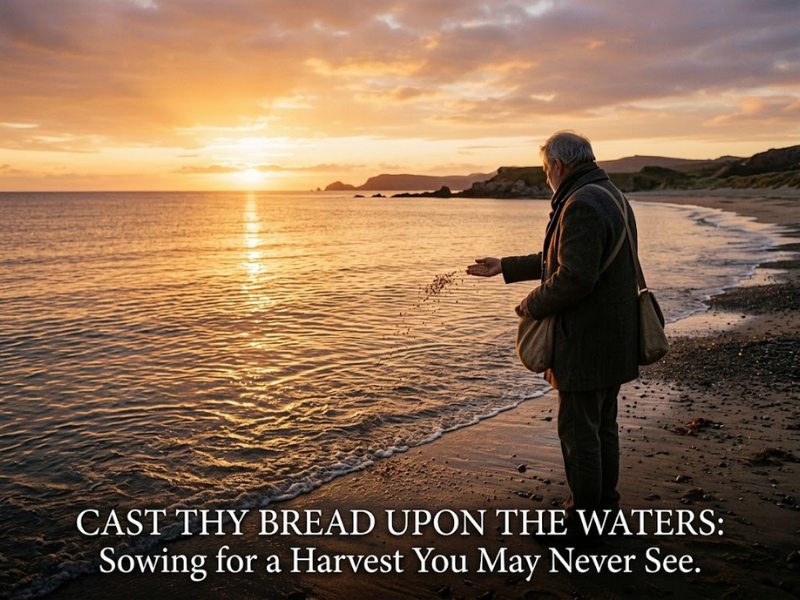
Key takeaways: Ecclesiastes 11:1 commands us to ‘cast thy bread upon the waters’ — to send out something valuable (provision, labor, the gospel) without demanding to see the return. Solomon tells us to give a portion to seven and also to eight, to sow in the morning and evening, and not to wait for perfect conditions. God promises we shall find it ‘after many days,’ in due season (Galatians 6:9).
Picture a merchant on the dock of a port during Bible times, watching a year’s worth of grain disappear into the hold of a ship bound for Tarshish. No manifest, no insurance, no way to send word ahead and no way to get word back. He watches the sail shrink until the horizon swallows it, and then he walks home.
And then he waits.
Solomon kept a navy at sea, and 1 Kings 10:22 tells us that the fleet came home once in three years.
Three years.
The man who loaded that ship in the spring lived through a thousand ordinary days before he learned whether he was rich or ruined. That is the world behind one of the most quoted and least understood verses in Scripture.
Ecclesiastes 11:1 — “Cast thy bread upon the waters: for thou shalt find it after many days.”
Well, by the time Solomon writes that line, he has spent ten chapters proving a point most of us would rather not admit. You cannot predict the weather, you cannot schedule your own death, and you cannot guarantee that whoever inherits your estate will manage it well or even keep it.
And here in chapter eleven, he finally tells us what to do about it: give it away, get to work, and leave the results with God.
What Does “Cast Thy Bread Upon the Waters” Actually Mean?
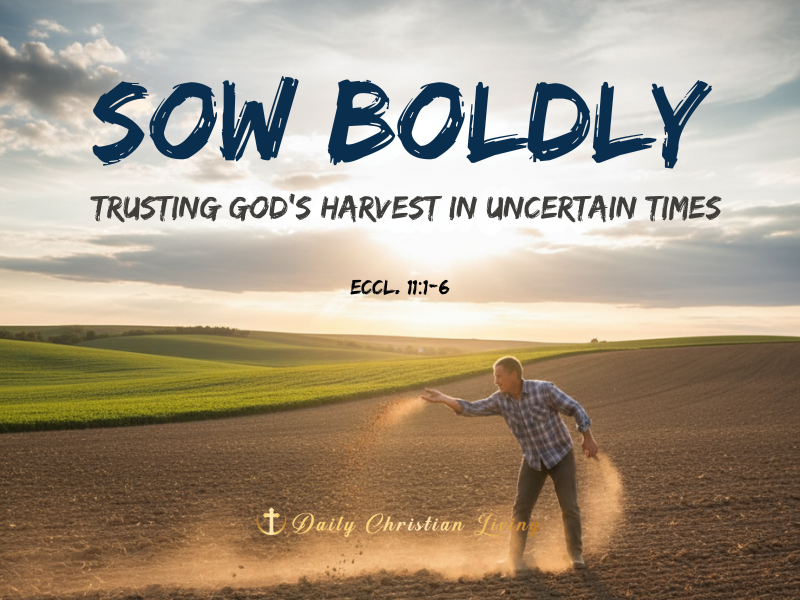
To cast bread upon the waters is to send out something genuinely valuable (your provision, your labor, your witness) into a future you cannot see or control, trusting God for a return you have no power to schedule. The bread is not leftovers, and the water is not safe.
Commentators read the verse two ways, and both of them preach.
The first is the merchant’s reading; grain was a trade good, and a man with capital sent his bread out over open water hoping it came back multiplied. Sometimes it never came back at all.
The second is agricultural. In the flooded fields of the ancient Near East, a farmer broadcast his seed out over standing water, and as the water receded the grain took root in the mud. From the road he looked like a man throwing good food into a puddle.
Isaiah paints the same picture: “Blessed are ye that sow beside all waters” (Isaiah 32:20).
Now, the Hebrew behind “cast” settles the tone of the whole verse. The word is shalach, and it does not mean to drop or discard. It is the verb for sending; a messenger, a servant, a man out on assignment.
Solomon is not telling us to be careless with what God put in our hands; he is telling us to commission it. And notice what gets sent. It is bread, lechem, the staple you were counting on to eat, not the crust left on the plate after everyone else has eaten.
Why Does Solomon Say to Give a Portion to Seven, and Also to Eight?
Because uncertainty is an argument for generosity rather than against it. Solomon tells us to spread our giving wide and to keep giving past the point where it feels imprudent, precisely because hard times may be coming. Most of us reason the other way and start hoarding.
Ecclesiastes 11:2 — “Give a portion to seven, and also to eight; for thou knowest not what evil shall be upon the earth.”Seven and eight is a Hebrew way of saying “as many as you can, and then one more.”
But the second half of the verse turns our thinking upside down.
Read it the way most of us instinctively would: trouble is coming, so tighten up and be generous later, once the ground stops shifting. That is the arithmetic of a nervous man, and every one of us has run those numbers.
Solomon looks at the same uncertain future and draws the opposite conclusion:
- You cannot time the trouble. Waiting for conditions to improve assumes you will get advance notice, and Solomon has spent ten chapters showing that you will not.
- Scattering is God’s economics. “There is that scattereth, and yet increaseth; and there is that withholdeth more than is meet, but it tendeth to poverty” (Proverbs 11:24).
- God supplies the giver. “Give, and it shall be given unto you; good measure, pressed down, and shaken together, and running over” (Luke 6:38).
Of course, that never makes the ledger feel better on the day you write the check.
Is This a Promise That God Will Pay You Back?
God has promised that faithful sowing will not be wasted, and He has not promised the form, the amount, or the date. This is a call to trust, not a formula for extracting money out of heaven. Any preaching that makes it a transaction walks right past verse 6.
This is one of the most abused verses on Christian television. Cast your bread on the waters; sow a thousand dollars into this ministry, name your harvest, and stand on the promise. The pitch always lands hardest on people who can least afford to lose the money. The text takes the legs out from under it.
Ecclesiastes 11:6 — “In the morning sow thy seed, and in the evening withhold not thine hand: for thou knowest not whether shall prosper, either this or that, or whether they both shall be alike good.”
Solomon flatly refuses to say which investment pays. He will not name your harvest, and he will not let you name it either. A man who could hand you the projected return on a bag of seed would not need faith to sow it. He would just need a calculator.
That said, we can end up in the opposite ditch, quietly concluding that God does not really notice and the sowing just disappears. Scripture will not let that stand either. “For God is not unrighteous to forget your work and labour of love” (Hebrews 6:10).
The return is certain; the terms belong to Him. Anyone who has held on to the goodness of God through a long silence has learned that the answer, when it came, looked nothing like the request.
Why Do So Many Believers Wait for the Perfect Moment to Serve?
Because there is always one more risk to weigh, and weighing risk feels responsible. Solomon calls it paralysis. The man studying the sky for perfect conditions never gets seed into the ground and never brings a harvest home. Waiting for certainty is itself a decision.
Ecclesiastes 11:4 — “He that observeth the wind shall not sow; and he that regardeth the clouds shall not reap.”
We all know this man. Actually, most of us have been this man.
He wants to talk to his neighbor about the Lord, but the timing has never once been right in eleven years of living next door. And every reason he gives is a real reason. That is what makes him so hard to argue with.
Solomon makes some strong arguments in this passage:
- You are not responsible for the weather. Clouds full of rain empty themselves, says verse 3, and where the tree falls, there it shall be. God has never asked a believer to guarantee the conditions.
- You are responsible for the seed. The wind and the clouds are His department. The bag of grain over your shoulder is yours.
- Both ends of the day count. Morning and evening, says verse 6, and by extension both ends of a life. The young man sows because he has time in front of him; the older man sows because he does not.
And here is where Solomon springs the trap. The word for “wind” in verse 4 is ruach. Watch what he does with it one verse later.
Ecclesiastes 11:5 — “As thou knowest not what is the way of the spirit, nor how the bones do grow in the womb of her that is with child: even so thou knowest not the works of God who maketh all.”
Same word. The man in verse 4 is standing there studying the ruach, trying to master the one thing verse 5 says he cannot even trace. Ruach carries wind, breath, and spirit all at once, and the ambiguity is the point. You cannot see it, you cannot hold it, and you certainly cannot steer it.
The Lord Jesus makes that same move in Greek: “The wind bloweth where it listeth… so is every one that is born of the Spirit” (John 3:8). The word there is pneuma, and it does the same double duty ruach does.
So you cannot engineer a conversion any more than you can steer a breeze, which ought to lift a weight off the parent who has prayed for a wayward child for years and quietly blamed himself for the delay. Bones knit together in the dark, out of sight, on a schedule nobody set and nobody can rush. That is how God does most of His work.
What Does “After Many Days” Look Like in the Fall of Life?
It looks like watching things you sowed decades ago come back in forms you never planned, usually through people rather than profits. In the second half of life, you start eating at tables you set before you had any idea what you were doing.
Many of us read “thou shalt find it after many days” and want to know how many days Solomon is talking about. We have cast bread that never seemed to come back. We have prayed for a prodigal for twenty years and watched him drift further out rather than closer in.
So how long is “many days”, exactly? That is a fair question, and Scripture does not dodge it.
Galatians 6:9 — “And let us not be weary in well doing: for in due season we shall reap, if we faint not.”
Due season is God’s phrase, not ours, and He has never handed out the calendar. What He gives instead is a picture, and it is worth reading Isaiah 55 a verse earlier than we usually start.
Isaiah 55:10–11 — “For as the rain cometh down, and the snow from heaven… that it may give seed to the sower, and bread to the eater: So shall my word be that goeth forth out of my mouth: it shall not return unto me void.”
Bread, water, sowing, and a return the sower did not manufacture. The promise that God’s Word will not return void is built on the same image as Ecclesiastes 11:1. So when we cast the Word out on the water (e.g., in a Sunday school class, over a dinner table, in a tract handed to a stranger), we are sowing the one seed God has guaranteed. And the longest returns almost always come back through people.
My own mother is ninety years old. She set the tone in our family as a prayer warrior, and she has never let up, still praying over children, grandchildren, and now great-grandchildren. Two of those great-grandsons are mine to look after, one just past two years old and the other about six months. She was casting bread upon the water before either boy had bones to be knit together, and it is still coming back in.
Paul does the same when he traces Timothy’s faith back two generations to a grandmother, the unfeigned faith “which dwelt first in thy grandmother Lois, and thy mother Eunice” (2 Timothy 1:5). Lois had no way of knowing the boy she prayed over would carry the gospel across the Roman Empire. She kept sowing into a household, and the bread came back after many days as a preacher.
We are not owed a view of the harvest. We are told to sow, and to raise up a generation who will tell the one after that (Psalm 78:7).
How Do We Remove Sorrow from the Heart?
By setting down the self-condemnation God never asked us to carry. The sorrow Solomon names is corrosive fretting rather than honest grief. A believer who has repented and still stumbles is called to keep repenting, without letting shame convince him that mercy has run out.
Ecclesiastes 11:10 — “Therefore remove sorrow from thy heart, and put away evil from thy flesh: for childhood and youth are vanity.”
The Hebrew rendered “sorrow” is ka’as — vexation, provocation, the gnawing irritation of a soul chewing on itself. The same word gets translated “grief” back in Ecclesiastes 1:18. So Solomon is not telling a grieving man to cheer up. He is telling us to quit letting the fretting eat us alive.
This speaks straight to the believer who has genuinely repented of a sin and keeps falling back into it from time to time or even fairly often. That man knows the cycle by heart. Confess, resolve, fail, hate himself, and start over feeling like a fraud.
Somewhere in there, the accuser begins whispering that a real Christian would have beaten this by now, and that whisper can often do more damage than the sin itself.
2 Corinthians 7:10 — “For godly sorrow worketh repentance to salvation not to be repented of: but the sorrow of the world worketh death.”
Conviction drives a man to the cross. Self-condemnation drives him into the ground. One is the Holy Spirit doing His work and the other is the enemy doing his, and at two o’clock in the morning they can feel remarkably similar.
Test it by where it sends you.
If it sends you running to Christ, then it is of God. There is therefore now no condemnation to them which are in Christ Jesus (Romans 8:1), and He is faithful and just to forgive us when we confess (1 John 1:9). Micah says the Lord casts our sins into the depths of the sea (Micah 7:19).
We cast our bread upon the water, and it comes back after many days. God casts our sins into the sea, and those never come back at all.
Now, Solomon does not go soft here. The verse just before says to rejoice in your youth, “but know thou, that for all these things God will bring thee into judgment” (Ecclesiastes 11:9). Put away the fretting, and put away the evil right along with it. He gives us leave to stop rehearsing the shame, not to make peace with the sin.
Have You Received the Bread God Cast Upon the Waters?
Before any of us ever cast so much as a crumb, God sent His only begotten Son into a world that had no intention of sending Him back. That is the first and greatest casting of bread upon the waters, and the return came three days after the tomb was sealed.
The word behind “cast” is the verb for sending, and sending is exactly what God did. He so loved the world that He sent, and the Bread He sent said so plainly: “I am the bread of life” (John 6:35). Then the casting language turns around on itself.
John 6:37 — “All that the Father giveth me shall come to me; and him that cometh to me I will in no wise cast out.”
You may have been cast out by family, cast off by friends, or cast aside by people who swore they would never leave. The Lord Jesus has never yet turned away one soul who came to Him, and He is not going to start with you. “For whosoever shall call upon the name of the Lord shall be saved” (Romans 10:13).
No pedigree, no probation, and no waiting for your fleet to come in. Admit that you are a sinner, believe that Christ died for you and rose again, and call on Him today.
Father, we thank You for sending Your Son into a world that did not want Him, and for a mercy that has never once cast away a soul who came. Teach us to send out what You have placed in our hands without demanding to know the return. Give us grace to sow in the morning and in the evening, and to leave the harvest in Your keeping. And where we are carrying a sorrow You never asked us to carry, help us set it down. In Jesus’ name, amen.
Comments are closed