
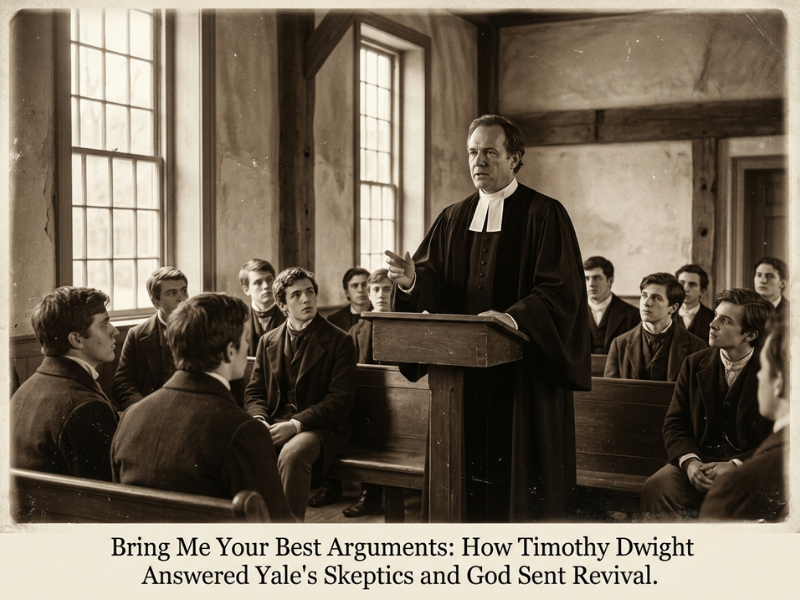
In the autumn of 1795, the new president of Yale College climbed the chapel steps for the first time and looked out over a student body that intended to eat him alive.
The young men in the pews knew all about the Reverend Timothy Dwight. They knew he was forty-three, an old-school New England Congregationalist, the grandson of the legendary Jonathan Edwards. They knew he had spent the last twelve years pastoring a sleepy country church. And they knew he was nearly blind — that he composed his sermons by dictation because he could not read for more than fifteen minutes without pain. In short, they figured the trustees had hired a relic.
The Yale that those students ruled was proud of its unbelief. The ideas of the French Revolution had crossed the Atlantic and hit American colleges like an earthquake, and the seniors made a show of addressing one another as Voltaire, Rousseau, and d’Alembert. They mocked Christianity in the dining hall and the dormitories and published satirical poems against the resurrection in the student papers. When the faculty quietly surveyed the senior class for who would be willing to profess faith in Jesus Christ in front of his peers, exactly one student raised his hand.
One. That was the campus Timothy Dwight inherited.
Now, most of us have never faced a chapel full of mocking seniors, but we know the room. It’s the break table where the Bible is a punch line, or the family dinner where a grown son explains why he doesn’t believe any of it anymore. And Dwight handled his room the wrong way for seven straight years before he found the right one.
Who Was Timothy Dwight?
Timothy Dwight IV (1752–1817) was Jonathan Edwards’ grandson, a child prodigy who entered Yale at thirteen, and the college’s president from 1795 until his death. Nearly blind from his early twenties, he answered a generation of student skeptics and presided over the revival of 1802 that helped launch a missionary century.
He was born on May 14, 1752, in Northampton, Massachusetts — the very town where his grandfather had preached “Sinners in the Hands of an Angry God” eleven years earlier — and he was a prodigy of the sort historians have trouble believing existed. Reading the Bible at four. Teaching himself Latin at seven. Yale at thirteen, valedictorian at seventeen.
But the brilliance came at a price. As an undergraduate, he woke at 3:30 in the morning to study, kept himself on a meager diet so hunger would not slow his work, and read by candlelight until his eyes ached — and in his early twenties, his body finally gave out. The most lasting damage from the collapse was to his eyes. For the rest of his life he could read only about fifteen minutes at a stretch before the pain forced him to stop. Every sermon, lecture, and book — including an eleven-thousand-line epic poem — would be composed by dictation while assistants read his sources aloud.
And it was in that darkened sickroom that God did His deepest work. Dwight had been raised on the family catechism, but he had treated Christianity as the inherited furniture of his mind rather than a living trust in Christ. Confined to bed, unable to read, forced for the first time in his life to think rather than merely study, he came to genuine repentance and personal faith. He rose from that bed with less of his eyesight and more of his soul.
The next chapters were quiet ones — a chaplaincy in the Continental Army, then twelve years as a country pastor in Greenfield Hill, Connecticut, where he founded an academy and taught farm children beside merchants’ sons. Then, in 1795, Yale’s president died in office, and the trustees’ search for a man who could restore the college’s soul ended at the nearly blind pastor’s door.
Why Did Seven Years of Confrontation Accomplish Nothing?
Seven years of direct confrontation accomplished nothing because arguments alone do not regenerate hearts. Dwight’s preaching against deism was learned, rigorous, and correct — and the students simply dug in. Repentance, Scripture says, is something God gives; our fiercest polemic cannot force open a heart that God has not yet softened.
Dwight’s first instinct was to do exactly what his training told him to do: confront the error head-on. He preached against deism from the chapel pulpit, denounced French infidelity in his lectures, and answered student skepticism with sermon after sermon designed to demolish the foundations of unbelief. The arguments were learned. The reasoning was rigorous. And it accomplished almost nothing.
Actually, it made things worse. The students who styled themselves after Voltaire now had a real fight on their hands, and they dug in — sharpening their objections, circulating forbidden books, reading satirical poems about the new president at their gatherings. Year one passed, and year two, and year three. The lone professing senior graduated, and his replacements were no warmer. The Christian fellowship on campus could meet comfortably in a single dorm room. By 1802 — seven years in — the greatest theological mind of his generation had moved the campus exactly nowhere.
Many of us have run the same play. We have a son home from college quoting his professors, or a brother-in-law who calls the Bible a fairy tale, and we come loaded with our best verses and our sharpest points — and every conversation ends a little worse than the one before. So we read about those seven years and wonder, “If the truth is on our side, why isn’t it winning?” That is a fair question, and the answer is not that truth failed. Paul told Timothy that repentance is something God gives — “if God peradventure will give them repentance” (2 Timothy 2:25) — which means the mightiest argument in the world cannot pry open a heart the Spirit has not yet softened. At Yale, the truth was not failing; Dwight’s delivery was getting in its way, and God’s hour had not yet come.
What Made “Bring Me Your Best Arguments” Different?
Instead of preaching at his students, Dwight invited them to put their strongest objections to Christianity in writing — then spent months of Sunday sermons answering them one by one, seriously and without mockery. He treated doubters as men worth persuading rather than enemies worth crushing, and the campus began to change.
So he changed tactics — and what he tried next was, by the standards of his era, almost shocking. Dwight invited the senior class to submit their strongest objections to the Christian faith in writing. Not their dining-hall jokes and not their fashionable poses — their actual, considered, intellectually serious objections. Whatever they believed most firmly against the Scriptures, he wanted it on paper.
The students assumed it was a setup. When it became clear he was serious, many obliged — partly from curiosity, partly hoping to finally pin the old Calvinist down. Dwight had the objections read aloud to him, sorted them, and announced that his Sunday chapel sermons for the next several months would answer them one by one.
And he kept his word without keeping score — no mockery, no condescension, no rushing to declare victory. He answered the philosophical objections by walking through Voltaire and Hume and showing where the reasoning broke down on its own terms.
He answered the historical objections by laying out the evidence for the resurrection like a careful courtroom advocate. He answered the moral objections by showing what Christian theology actually teaches about the goodness of God and the dignity of man. And he did it all with the same patient warmth he had once used to teach Latin to farm children.
Well, the campus began to change. Slowly at first — a new seriousness in the pews, late-night arguments in the dormitories about what they had heard from that pulpit, then small prayer meetings, then students showing up at Dwight’s study, some of them weeping, asking what they were supposed to do about the conviction that had settled on them.
What Does the Bible Say About Answering Skeptics?
Scripture commands us to be ready with an answer and gentle in giving it. First Peter 3:15 calls every believer to a reasoned defense of the hope within us, and 2 Timothy 2:24–25 forbids the Lord’s servant to strive — because it is God, not our arguments, who grants repentance.
Dwight would have said he was simply obeying two plain commands. The first is Peter’s:
1 Peter 3:15 — “But sanctify the Lord God in your hearts: and be ready always to give an answer to every man that asketh you a reason of the hope that is in you with meekness and fear:”
The word translated “answer” is the Greek apologia — a reasoned defense — a courtroom word, and the root of “apologetics”. Peter wrote that to ordinary, persecuted believers, not professors — every Christian is called to know why he believes and be ready to say so. But notice also how the answer is to be given — with meekness and fear. “Meekness” translates prautēs, and it does not mean weakness; it means strength under control, power that has taken the bridle. The second command says the same thing from the other side:
2 Timothy 2:24–25 — “And the servant of the Lord must not strive; but be gentle unto all men, apt to teach, patient, In meekness instructing those that oppose themselves; if God peradventure will give them repentance to the acknowledging of the truth;”
Let’s be plain about the two ditches here. Plenty of Christians today treat apologetics like a cage match — win the exchange, humiliate the skeptic, post the clip. You can win the argument and lose the man, and many of us have. But the opposite ditch is just as deep: some pulpits are so nervous about hard questions that they have quit answering anything at all, trading doctrine for good feelings and hoping nobody asks about the resurrection.
Dwight refused both ditches. He never softened a syllable of the theology — he was Jonathan Edwards’ grandson, after all — but he delivered it the way Proverbs 15:1 prescribes: “A soft answer turneth away wrath.” Conviction in the content, gentleness in the delivery. Colossians 4:6 puts both in one verse: “Let your speech be alway with grace, seasoned with salt, that ye may know how ye ought to answer every man.”
What Happened When Revival Came to Yale?
By the end of 1802, roughly seventy-five of Yale’s two hundred thirty students had professed faith in Christ — one in three — and more than thirty entered the ministry. The converts of Dwight’s chapel went on to help found Andover Seminary, America’s foreign missions board, and the American Bible Society.
By the spring of 1802, the change was impossible to ignore, and when the revival broke, it broke quietly and decisively. By year’s end, roughly seventy-five students out of two hundred thirty had professed faith in Christ, and more than thirty of them committed to the ministry. The satirical poems stopped. The fashionable nicknames disappeared. One student wrote home that Yale had become “a little temple.”
And the fire did not stay in New Haven. The converts of Dwight’s chapel fanned out into every corner of American life. In 1808, Dwight helped found Andover Theological Seminary, the first graduate seminary in the country. In 1810, four Andover men — among them Adoniram Judson — asked a meeting of Massachusetts ministers to send them overseas, and the stunned ministers founded the American Board of Commissioners for Foreign Missions on the spot — more than twelve hundred missionaries would go out in its first fifty years. In 1816 came the American Bible Society.
Lyman Beecher sat under Dwight, along with generations of pastors and reformers who shaped the century ahead. Williams, Amherst, Bowdoin, and a dozen other Christian colleges traced lines back to that chapel.
The revival tide rolling out of New Haven even reached into the home of Noah Webster — the dictionary man — whose grown daughters came to Christ in it and then led their famous father to the Savior in his fiftieth year.
It was not a single revival so much as a long detonation. Seven years of pushing had moved nothing; one season of patient answering, and the echo ran through American life for half a century. Of course, Dwight would have been the first to say the timing was never his to command.
How Can We Answer the Skeptics in Our Own Lives?
We answer skeptics the way Dwight did: welcome the hard question instead of dreading it, learn why we believe what we believe, answer with meekness instead of scorekeeping, and give God time to work. Our job is a faithful answer and a warm heart; repentance is His department.
None of this requires a Yale presidency. The pattern is available to any believer with a Bible, a listening ear, and a little patience:
- Welcome the question instead of dreading it. Invite your skeptic to give you his real objections — even in writing, like Dwight did. A question out in the open can be answered; a question mocked goes underground and grows.
- Learn why you believe. “Be ready always” is a command with homework in it. You do not need a seminary degree, but you do need to know what you believe about the Scriptures, the resurrection, and the gospel — and why — before the conversation starts.
- Answer with meekness, not scorekeeping. The goal is never to win the exchange; it is to win the person, for “he that winneth souls is wise” (Proverbs 11:30). Keep your voice soft and your doctrine firm.
- Give God time. Dwight failed for seven years before the breakthrough. Keep answering, keep praying, and let God set the calendar — repentance is His gift to give, not ours to force.
One more thing, and it matters. The man who did all this could not read his own Bible for more than fifteen minutes at a time. For twenty-two years, nearly blind, Dwight answered a generation’s questions from memory and dictation. So whatever weakness makes you feel disqualified — age, education, a stammer, a past — hear the Lord’s word to another struggling servant:
2 Corinthians 12:9 — “And he said unto me, My grace is sufficient for thee: for my strength is made perfect in weakness.”
Will You Reason Together With God?
God invites honest doubters to bring Him their questions — “Come now, and let us reason together” — and He promises cleansing to everyone who comes. Salvation is received by admitting you are a sinner, believing Jesus died for you and rose again, and calling on Him in faith.
Maybe you are not the one answering the questions. Maybe you are the one asking them — and maybe you have assumed God has no patience for a doubter. Friend, the record says otherwise. When Thomas doubted the resurrection, Jesus did not lecture him; He showed him His hands, and Thomas fell down crying, “My Lord and my God” (John 20:27–28). And centuries before that, God issued an open invitation:
Isaiah 1:18 — “Come now, and let us reason together, saith the LORD: though your sins be as scarlet, they shall be as white as snow; though they be red like crimson, they shall be as wool.”
Notice where the reasoning leads — not to a debate trophy, but to cleansing. All of us have sinned and come short of the glory of God (Romans 3:23), and an honest examination of the evidence ends at a cross and an empty tomb. “For whosoever shall call upon the name of the Lord shall be saved” (Romans 10:13). Admit you are a sinner. Believe that Jesus died in your place and rose again. Call on Him today — and bring your questions with you, because He has never once been afraid of them.
Let us pray:
Father, thank You that You invite sinners to come and reason together with You. Make us ready always to give an answer for our hope, and teach us to answer with meekness — soft voices and unbending truth. Give us patience with the doubters at our tables and on our jobs, and take the glory when hearts finally turn. And if a doubter is reading this now, may this be the day they bring You their questions and receive Your salvation. In Jesus’ name, amen.
Comments are closed