
We have spent weeks walking through the anticipation of Advent. We have seen how God interrupts our carefully laid plans, just as He did with Mary. We have learned to offer praise before the proof arrives, echoing the song of Hannah. We have watched Joseph model the quiet, steadfast obedience that trusts God in the shadows.
But anticipation, by its very nature, demands a conclusion. A promise is only as good as its fulfillment.
Now, the waiting ends. The silence is broken. The “divine drama” that began with whispers in the temple and dreams in Nazareth culminates not in a royal palace or a fortress of power, but in the most unlikely of places.
Imagine the contrast. The Creator of the universe, the One who holds the stars in place, enters human history—not with a retinue of guards, but amid the bureaucratic headache of a Roman census. He arrives not to the fanfare of trumpets in Rome, but to the bleating of sheep in a Judean hillside.
The Savior of the world is born in humble obscurity, yet His arrival splits history in two.
For us, living in a world that is loud, chaotic, and often hostile to faith, the nativity narrative invites us to stop scrolling, stop striving, and simply encounter wonder in the ordinary. It reminds us that God’s promises are not just poetic sentiments; they are concrete realities that arrive in His perfect timing. The hope we have waited for is no longer a concept; He is a Person.
The Context: Caesar’s Decree and God’s Direction
The narrative in Luke 2 begins with a display of worldly power: “And it came to pass in those days, that there went out a decree from Caesar Augustus that all the world should be taxed” (Luke 2:1).
Caesar likely thought he was simply balancing the Roman budget and consolidating power. But from the perspective of Heaven, the most powerful man in the world was merely an errand boy for the Almighty. God moved the heart of an emperor thousands of miles away just to get a carpenter and his espoused wife from Nazareth to Bethlehem.
Why? To fulfill a prophecy written 700 years earlier by the prophet Micah: “But thou, Bethlehem Ephratah, though thou be little among the thousands of Judah, yet out of thee shall he come forth unto me that is to be ruler in Israel” (Micah 5:2).
Joseph and Mary make the arduous trek. When they arrive, the town is teeming with descendants of David. We know the scene well, perhaps too well.
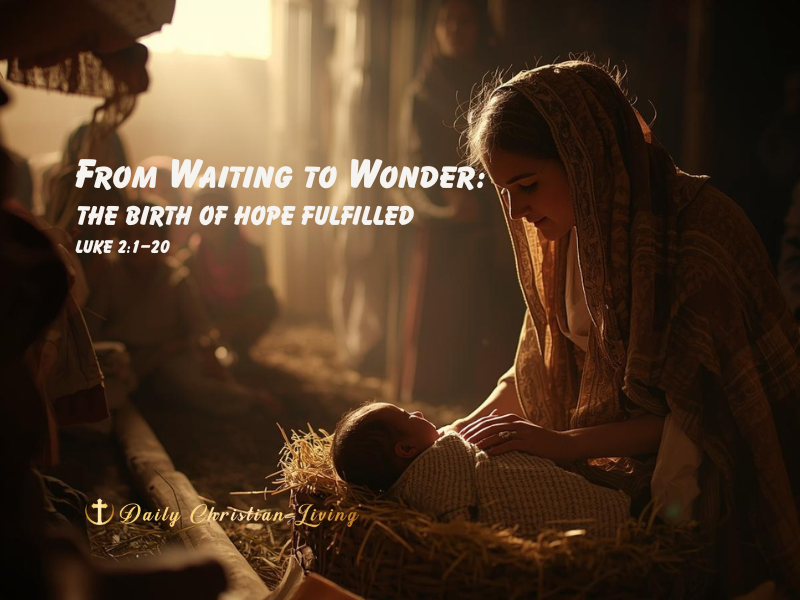
Luke 2:7 says simply, “And she brought forth her firstborn son, and wrapped him in swaddling clothes, and laid him in a manger; because there was no room for them in the inn.”
There is no room for the King of Glory. The progression we have tracked—from the Annunciation to the Magnificat to Joseph’s obedience—leads to this pivotal moment of Incarnation. God has become flesh, and His first throne is a feeding trough.
The Shepherds: The First Audience of Grace
While the town slept, oblivious to the miracle in the stable, God chose His first audience. He didn’t send Gabriel to the high priests in Jerusalem or the nobles in Herod’s court. He sent him to the night shift.
The Angelic Proclamation (Luke 2:8–14)
Luke 2:8 tells us there were “shepherds abiding in the field, keeping watch over their flock by night.” Shepherds were often marginalized figures in that culture—rough, poor, and ceremonially unclean due to their work. Yet, they were the first to hear the Gospel.
Suddenly, the angel of the Lord came upon them, and the glory of the Lord shone round about them. Naturally, “they were sore afraid” (v. 9).
But the angel’s message cuts through the terror: “Fear not: for, behold, I bring you good tidings of great joy, which shall be to all people. For unto you is born this day in the city of David a Saviour, which is Christ the Lord” (vv. 10-11).
Notice the specificity. This isn’t just a “good teacher” or a “prophet.” This is the Saviour. This is Christ (the Messiah). This is the Lord (Jehovah).
The sign given to them was stark in its simplicity: “Ye shall find the babe wrapped in swaddling clothes, lying in a manger” (v. 12). A king in a palace is normal; a Savior in a feed box is a sign.
Then, the sky explodes with praise. A multitude of the heavenly host appears, praising God and saying, “Glory to God in the highest, and on earth peace, good will toward men” (v. 14).
This choice of audience is profound. It symbolizes God’s preference for the humble. The Gospel is inclusive; it is “to all people,” starting from the bottom up.
The Urgency of the Response (Luke 2:15–16)
When the angels went away, the shepherds didn’t debate the theology or wait for sunrise. Verse 15 says, “Let us now go even unto Bethlehem, and see this thing which is come to pass.”
There is a holy urgency here. Verse 16 tells us they “came with haste.”
Contrast this with the indifference of the innkeeper or the religious leaders who knew the prophecies but didn’t bother to check. The shepherds demonstrate faith in action. They prioritized divine revelation over their routine duties. When God speaks, the only proper response is immediate obedience.
Encounter and Verification (Luke 2:16)
They found “Mary, and Joseph, and the babe lying in a manger.” It was exactly as the angel had said.
This moment transforms the abstract announcement into a personal encounter. It validates the Word of God. The shepherds walked in with hearsay; they walked out with eyewitness testimony. The trustworthiness of the heavenly message was proven in the straw of the stable.
From Recipients to Evangelists (Luke 2:17–18)
What do you do when you meet the Savior? You talk about it.
“And when they had seen it, they made known abroad the saying which was told them concerning this child” (v. 17).
These rough, uneducated men became the first evangelists of the New Testament era. They didn’t have a seminary degree; they had a story. They had an encounter. And verse 18 tells us that “all they that heard it wondered at those things.”
This models the Christian life for us. We are not called to be experts; we are called to be witnesses. A witness simply tells the truth about what they have seen and heard.
The Cycle of Worship (Luke 2:20)
The narrative arc of the shepherds ends with worship. “And the shepherds returned, glorifying and praising God for all the things that they had heard and seen, as it was told unto them.”
They went back to the sheep, back to the cold night, back to the same job—but they were different men. Their worship integrated their experience with God’s revelation. They moved from fear to awe, from isolation to community impact.
The Old Testament Parallel: The Greater David
It is impossible to miss the connection to 1 Samuel 16–17. A thousand years earlier, another shepherd boy named David walked these same Bethlehem hills. He was the unlikely choice, the youngest son, anointed king while still smelling of sheep.
Now, the “Greater David” is born in the same city, announced to the same class of men. God is consistent. He lifts the poor from the dust and makes them sit with princes (1 Samuel 2:8). The Good Shepherd has come to lay down His life for the sheep.
The Arrival of the Wise Men: Worship from the Nations
While Luke focuses on the humble Jewish shepherds, Matthew’s Gospel widens the lens to include the Gentiles. The arrival of the Wise Men (Magi) underscores that this King is not just for Israel, but for the world.
The Journey of Faith (Matthew 2:1–8)
We read in Matthew 2 that wise men from the east—likely Persia or Babylon—arrived in Jerusalem. These were scholars, astronomers, and perhaps king-makers in their own lands. They asked the question that unsettled the establishment: “Where is he that is born King of the Jews? for we have seen his star in the east, and are come to worship him” (Matthew 2:2).
Herod the Great, a paranoid tyrant, was troubled, and all Jerusalem with him. While the Gentile strangers were seeking to worship, the religious leaders in Jerusalem were indifferent, and the political leader was hostile.
It is a sobering reminder that proximity to the truth does not equal love for the truth.
Guided by Scripture and Star
The scribes knew the answer intellectually: “In Bethlehem of Judaea” (Matthew 2:5). They quoted Micah 5:2 perfectly but didn’t move an inch to go see Him. The Magi, however, acted on the light they had.
As they departed Jerusalem, the star went before them. Matthew 2:10 records their reaction: “When they saw the star, they rejoiced with exceeding great joy.”
This is the “wonder” that comes after a long, arduous search. They had traveled hundreds of miles, likely for months, fueled by hope.
Treasures for the King (Matthew 2:11)
When they entered the house (note that by this time, the family was in a house, not the stable), they saw the young Child with Mary. Their response was immediate and physical: they “fell down, and worshipped him.”
These powerful men prostrated themselves before a toddler. Then, they opened their treasures.
- Gold: A gift for a King. It acknowledged His sovereignty.
- Frankincense: A gift for a Deity. Used in temple worship, it acknowledged His divinity.
- Myrrh: A gift for a Sacrifice. Used in embalming, it was a prophetic acknowledgment that this King was born to die.
Contrast this with the shepherds. The shepherds came with haste and empty hands; the Wise Men came with dignity and laden with treasure. Both were accepted. Both worshipped.
God does not look at the size of the offering, but the sincerity of the heart.
The First Gentile Homage
This moment fulfills the psalmist’s cry in Psalm 72:10–11: “The kings of Tarshish and of the isles shall bring presents: the kings of Sheba and Seba shall offer gifts. Yea, all kings shall fall down before him.”
It echoes Isaiah 60:6: “All they from Sheba shall come: they shall bring gold and incense.”
The door of salvation was swinging open to the nations.
From Waiting to Wonder
What connects the shepherds and the Magi? It is the shift from expectation to realization—from waiting to wonder.
Advent is a season of waiting. We wait for the celebration. We wait for God to move in our lives. We wait for answers to prayer. But the Christmas story assures us that the wait has an expiration date.
God’s timing is precise. He moved Caesar to get Mary to Bethlehem on time. He moved a star to get the Magi to the house on time.
But we also learn that God’s arrivals often exceed our expectations while appearing deceptively ordinary. The shepherds expected a Messiah and found a baby. The Magi expected a royal palace and found a humble home. Yet, in that ordinary setting, they found the “peace of God” the angels sang about.
Peace doesn’t come from understanding everything; it comes from encountering Christ personally. Like Mary and Joseph trusting amid uncertainty, the shepherds and Wise Men model an urgent response to God’s word. They didn’t just spectate; they participated.
Practical Application: “Go and See”
In the rush of Christmas morning—the wrapping paper, the cooking, the noise—it is easy to miss the Christ.
This week, the challenge is to pause. Don’t just read the story; enter it.
“Go and see” Christ anew.
- Through Scripture: Read Luke 2 slowly with your family before the gifts are opened.
- Through Worship: Like the Magi, offer Him your “gold” (your resources), your “frankincense” (your praise), and your “myrrh” (your suffering and sorrows).
- Through Service: Like the shepherds, share the good news.
Simple Practice: This week, be a shepherd. Share one “good tidings” story with someone. Tell a friend, a child, or a neighbor about a time God was faithful to you. Let your testimony be the thing that causes them to “wonder.”
Closing Reflection
The manger scene transforms our waiting into wonder. It assures us that Hope has not just “come,” but is here to stay. The long night is over. The Light has dawned.
Father, we thank You that You are a God who keeps His promises. Thank You for the gift of Immanuel—God with us. Forgive us when we become numb to the miracle of the Incarnation. Give us the eyes of the shepherds to see Your glory in the ordinary, and the heart of the Wise Men to pursue You with everything we have. May we return to our fields and our families glorifying and praising You. In the name of Jesus, our born King. Amen.
Comments are closed