
Victory often lies in your ability to see hope where others see hopelessness.
That statement cuts straight to the heart of the Christian experience, especially in the weeks leading up to Resurrection Sunday. The world looked at the cross on Good Friday and saw defeat. The disciples scattered into the night, their dreams crushed and their faith shaken. Every human eye saw hopelessness.
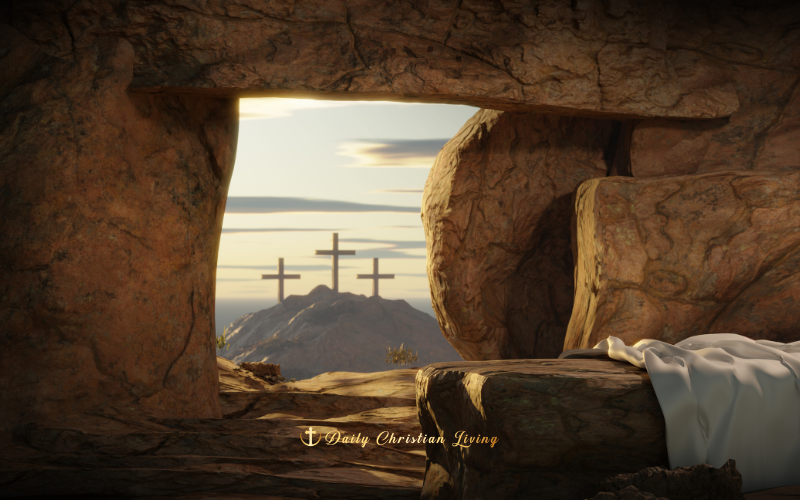
But God saw something entirely different. He was already working resurrection power while the stone still sealed the tomb.
That is the essence of biblical hope, and it belongs to every believer, not just on Easter morning, but right now, in this very season of anticipation.
What Is the Season of Hope?
The weeks leading up to Resurrection Sunday represent far more than a countdown on the calendar. For the Christian, this is the season of hope, a time to fix our minds and hearts on the reality of what Christ accomplished through His death, burial, and resurrection. This season is not about religious ritual or church tradition. It is about actively remembering that we serve a risen Savior whose victory over death is the foundation of everything we believe.
Consider where the disciples stood on that dark Saturday between the crucifixion and the resurrection.
Their Lord was dead. Their movement appeared finished. Every visible circumstance screamed that hope was gone. Yet in that silent, seemingly hopeless interval, God was doing His greatest work. The seed was in the ground, and the harvest of all eternity was about to break forth.
We know something the disciples did not know on that Saturday.
We know Sunday is coming. We know the tomb is empty. And that knowledge transforms how we live every single day. This is not a season of mourning a dead teacher, it is a season of anticipating the celebration of a living King.
The apostle Peter captures this beautifully:
1 Peter 1:3 “Blessed be the God and Father of our Lord Jesus Christ, which according to his abundant mercy hath begotten us again unto a lively hope by the resurrection of Jesus Christ from the dead.”
Notice Peter’s phrase: “a lively hope.” The Greek word here is zao, meaning living, active, and vital. Our hope is not dead theology sitting on a shelf. It is a living, breathing, powerful reality born directly from the resurrection of Jesus Christ. Because He lives, our hope lives. It is not fragile. It is not uncertain. It is alive with the same power that rolled the stone away.
What Does Scripture Teach About the Nature of Biblical Hope?
The world uses the word “hope” to describe wishful thinking—a vague desire for something that may or may not happen. “I hope it doesn’t rain.” “I hope I get the job.” But biblical hope is an entirely different substance.
The Greek word elpis, used throughout the New Testament, carries the meaning of confident expectation grounded in the promises and character of God. It is certainty directed toward the future.
Romans 8:24 “For we are saved by hope: but hope that is seen is not hope: for what a man seeth, why doth he yet hope for?”
Paul is teaching us that hope, by its very nature, deals with what is not yet visible. If you could see it, you would not need hope.
Hope operates in the gap between God’s promise and its fulfillment. It is the bridge that carries us from “not yet” to “there it is.” And the strength of that bridge is not determined by our feelings or circumstances—it is determined by the faithfulness of the God who made the promise.
This is precisely why faith and hope are so closely linked:
Hebrews 11:1 “Now faith is the substance of things hoped for, the evidence of things not seen.”
Faith gives substance—actual reality—to the things we hope for. It treats God’s promises as settled fact. When God says He will do something, faith responds by saying, “It is as good as done.” That is not reckless optimism. That is reasonable confidence in an omnipotent, unchanging God who cannot lie.
The writer of Hebrews goes even further:
Hebrews 6:19 “Which hope we have as an anchor of the soul, both sure and stedfast, and which entereth into that within the veil.”
An anchor does not prevent the storm, but it prevents the ship from being driven onto the rocks. Biblical hope anchors our souls to the throne of God Himself, holding us steady when the winds of life blow hardest. The storms may rage, but the anchor holds.
And consider what Paul tells us about the very source of hope:
Romans 15:13 “Now the God of hope fill you with all joy and peace in believing, that ye may abound in hope, through the power of the Holy Ghost.”
God is not merely the object of our hope, He is called “the God of hope.” Hope flows from His very nature. When we draw near to Him, we are drawing near to the source of all hope, and we are filled with joy and peace as a result.
Why Is Hope the True Source of Our Joy?
Many Christians search for joy in changed circumstances, a better job, improved health, a restored relationship. But Paul locates the source of joy somewhere far more permanent:
Romans 5:2 “By whom also we have access by faith into this grace wherein we stand, and rejoice in hope of the glory of God.”
Read that carefully. Paul does not say we rejoice because everything is fixed. He says we rejoice in hope of the glory of God.
Our joy is rooted in what is coming, not in what is currently happening around us. The glory of God (His ultimate triumph, His full revelation, the consummation of His plan) that is what makes the Christian heart sing, even in the darkest valley.
Paul then expands this truth in one of the most remarkable progressions in all of Scripture:
Romans 5:3–5 “And not only so, but we glory in tribulations also: knowing that tribulation worketh patience; And patience, experience; and experience, hope: And hope maketh not ashamed; because the love of God is shed abroad in our hearts by the Holy Ghost which is given unto us.”
Notice the chain: tribulation produces patience, patience produces experience (or proven character), and proven character produces hope. This is counterintuitive to the world. The world says tribulation produces despair. But for the Christian, suffering refines us and deepens our hope, because every trial we endure proves once again that God is faithful.
And that hope, Paul says, “maketh not ashamed”—it will never disappoint, never leave us empty-handed, because God’s love has been poured into our hearts through the Holy Spirit.
This is why the Christian can have joy when the world offers none. Our joy is not tethered to the stock market, the election cycle, or the medical report. It is tethered to the empty tomb and the living Christ who sits at the right hand of God.
What Does It Mean to Be a Happy Warrior for Christ?
If hope is our anchor and joy is our birthright, then the default posture of the Christian life is that of a “happy warrior”. We are not fighting for victory, we are fighting from victory. The decisive battle has already been won. The cross was the payment. The empty tomb was the receipt. Satan is a defeated enemy operating on borrowed time.
John 16:33 “These things I have spoken unto you, that in me ye might have peace. In the world ye shall have tribulation: but be of good cheer; I have overcome the world.”
Jesus did not say, “Be of good cheer because I will eventually overcome the world.” He said, “I have overcome.”
Past tense. Completed action. The victory is already secured. Our battles on this earth are real, but they are not uncertain. We know how the story ends.
This truth shapes how we engage the world.
We do not fight with anger, bitterness, or despair. We fight with the stubborn joy of those who know the outcome. We forgive when it costs us something. We love even when it is not returned. We keep pressing forward when every voice around us says to quit.
And the remarkable side effect of this posture is that the world notices.
They see the husband who keeps leading his family with patience. They see the coworker who refuses to gossip. They see the mother who keeps praying for the prodigal with unshakeable faith.
That is how the world gets changed; not through political conquest or cultural domination, but through the quiet, relentless witness of believers who live as though the tomb is still empty. Because it is.
2 Corinthians 2:14 “Now thanks be unto God, which always causeth us to triumph in Christ, and maketh manifest the savour of his knowledge by us in every place.”
God always (not sometimes, not occasionally) always leads us in triumph. Our lives are meant to carry the fragrance of Christ’s victory into every room, every workplace, every neighborhood we enter.
How Do We Keep Our Eyes Fixed Above When the World Is in Turmoil?
The headlines are relentless. War, economic instability, cultural decay, and moral confusion press in from every side. The temptation is to let the chaos define our emotional state and steal the joy that Christ has purchased for us. But Paul gives us a clear directive:
Colossians 3:1–2 “If ye then be risen with Christ, seek those things which are above, where Christ sitteth on the right hand of God. Set your affection on things above, not on things on the earth.”
This is not a call to ignore reality. Christians are not ostriches burying their heads in the sand. We are fully aware of the brokenness around us. But we refuse to let it own us.
Setting our affection on things above means that our deepest loyalties, our strongest hopes, and our greatest investments are directed toward the eternal kingdom, not the temporary chaos of this fallen world.
2 Corinthians 4:17–18 “For our light affliction, which is but for a moment, worketh for us a far more exceeding and eternal weight of glory; While we look not at the things which are seen, but at the things which are not seen: for the things which are seen are temporal; but the things which are not seen are eternal.”
Paul calls his afflictions “light” and “momentary”—and this is a man who was beaten, stoned, shipwrecked, and imprisoned. How could he say that? Because he had an eternal frame of reference.
When you measure your troubles against the infinite glory that awaits, even the heaviest burden becomes light by comparison. Perspective is everything, and the resurrection of Christ gives us the ultimate perspective.
The prophet Isaiah offers a precious promise for those who fix their eyes upward:
Isaiah 40:31 “But they that wait upon the LORD shall renew their strength; they shall mount up with wings as eagles; they shall run, and not be weary; and they shall walk, and not faint.”
Waiting on the Lord is not passive inactivity. It is active trust, expectant patience, and deliberate dependence on His timing and His power. And the result is renewed strength, the kind of strength that enables you to rise above the turbulence rather than being consumed by it.
How Can We Walk in Hope as We Approach Resurrection Sunday?
As we move through this season, here are practical ways to walk in the hope that Scripture promises:
- Anchor your mornings in Scripture.
Begin each day by reading a passage that reinforces the reality of the resurrection and the hope it provides. Passages like Romans 8, 1 Peter 1, and Psalm 27 are excellent starting points. Let God’s Word set the trajectory of your day before the news cycle attempts to do it for you.
- Pray with confident expectation.
Prayer is not throwing wishes into the wind. It is approaching the throne of a God who has already demonstrated His power over death itself. Bring your burdens to Him with the same confidence that the empty tomb warrants.
- Refuse to let circumstances dictate your joy.
This is a daily, deliberate choice. When trouble comes, remind yourself of the truth of Romans 5:3–5—that tribulation is producing something eternal in you. Choose to rejoice in hope, not in outcomes.
- Be a witness of hope to others.
The world around you is drowning in anxiety and despair. Your steady, hopeful demeanor is a testimony. When someone asks why you are not consumed by the same fear that grips the culture, be ready to point them to Christ and the empty tomb.
- Gather with other believers.
Hope is strengthened in fellowship. Hebrews 10:25 urges us not to forsake the assembling of ourselves together. Surround yourself with brothers and sisters who share your hope and who will encourage you to keep your eyes fixed on eternity.
A Living Hope for Every Day
The tomb is empty. Christ is risen. And because of that, our hope is the permanent foundation of the Christian life. As we walk through this season toward Resurrection Sunday, let us carry that hope with us into every conversation, every challenge, and every quiet moment.
You do not have to win every battle on this earth. The war has already been won. Your job is to live like it; to love, to serve, to endure, and to point every soul you meet to the risen Christ who conquered death for them.
Psalm 27:13–14 “I had fainted, unless I had believed to see the goodness of the LORD in the land of the living. Wait on the LORD: be of good courage, and he shall strengthen thine heart: wait, I say, on the LORD.”
Wait on Him. Walk in hope. And never forget—Sunday is coming.
No responses yet