
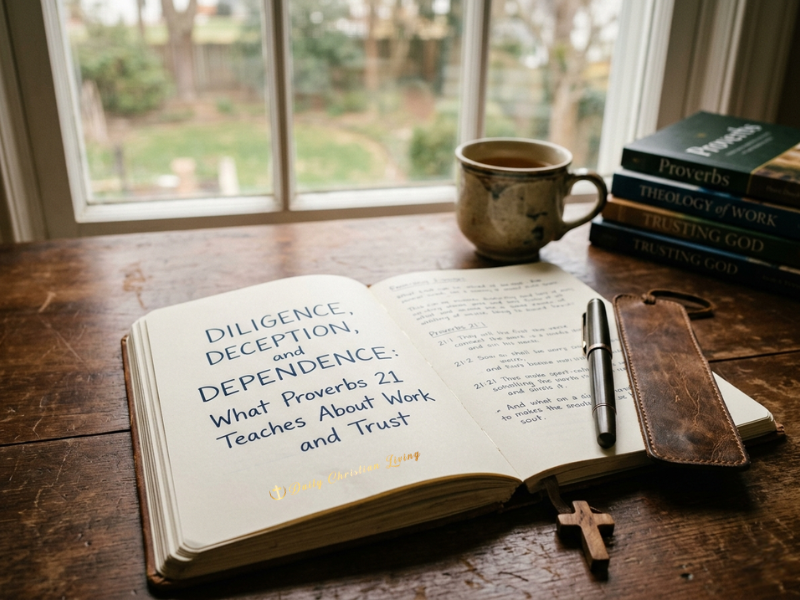
Most Christians feel pulled in two directions when it comes to ambition. One voice insists hard work is the answer—rise early, plan thoroughly, push past every limit. Another insists effort itself is the problem—just trust God and let go. Both claim biblical support, and both leave the believer uncertain about whether to grip the plow or fold the hands.
Proverbs 21 refuses to choose. Solomon, writing under the inspiration of the Holy Ghost, weaves diligence and dependence into the same chapter. The hand of the worker matters. The heart of the worker matters more. And the will of God overrules every plan a man can draft. Solomon opens with a sweeping declaration of God’s sovereignty:
Proverbs 21:1 The king’s heart is in the hand of the LORD, as the rivers of water: he turneth it whithersoever he will.
If even kings cannot move outside the channel God carves for them, neither can our careers, our finances, or our families. Yet the same chapter commands the believer to think carefully and plan diligently. Biblical wisdom calls us to diligent effort while keeping us from trusting in that effort.
Why Does Diligent Thinking Lead to Plenty While Haste Leads to Want?
Diligence is a steady, careful, planned effort that thinks before it acts; haste is a reactive, panicked motion that skips the thinking and pays for it later. Solomon promises that the first leads to abundance and the second leads to lack—not because God rewards busyness, but because He has built His world to honor wisdom and expose folly.
Proverbs 21:5 The thoughts of the diligent tend only to plenteousness; but of every one that is hasty only to want.
The Hebrew word for “diligent” is charuts, a word that pictured something sharp—a threshing sledge that cut through grain with precision. The diligent man is sharp; he cuts through indecision and slogans, weighs his decisions, and plans. The word for “hasty” is ‘ats—pressed, pushed, hurried—the man who reacts to every shiny opportunity and loud crisis without asking whether his actions are wise.
Solomon traces fruit back to its root. Plenty does not come from frantic motion; it comes from careful planning carried out by steady hands:
Proverbs 24:27 Prepare thy work without, and make it fit for thyself in the field; and afterwards build thine house.
First the field, then the house. The Lord Jesus taught the same lesson when He warned His disciples to count the cost before building a tower (Luke 14:28). Diligence is sanctified attention—treating time as stewardship and tasks as opportunities to honor God.
How Can a Mere Wish Become a Death Sentence?
The slothful man is not killed by what he does but by what he refuses to do. He has desires, often strong and even noble desires, but his hands will not work. The wish without the work withers him spiritually, financially, and relationally—because God has tied harvest to faithful sowing.
Proverbs 21:25 The desire of the slothful killeth him; for his hands refuse to labour.
The Hebrew word for “desire” is ta’avah—a strong, powerful longing, the same family of words used for the lusts of the flesh. Solomon’s point is sobering: desire by itself is no virtue. A slothful man can desire mightily and still die poor and unfruitful, because longing without labor produces nothing but bitterness.
Proverbs 13:4 The soul of the sluggard desireth, and hath nothing: but the soul of the diligent shall be made fat.
James writes the New Testament version when he warns that faith without works is dead, being alone (James 2:17). A faith that wishes to please God but never obeys Him is not living faith. A desire to grow that never opens the Bible is not spiritual hunger; it is religious sentimentality. God has bound the seed to the harvest. He gives increase, but He gives it through faithful planting.
Slothfulness rarely looks like a man asleep on a couch. It looks like an endless string of intentions never carried out:
- Wanting to be in the Word every morning but never opening the Bible before the phone.
- Longing to share the gospel with a coworker for years without ever asking the first question.
- Hoping for spiritual growth while skipping prayer, fellowship, and the local church.
- Planning to disciple the children “someday” while another year of bedtimes passes without family worship.
Paul did not soften the warning when he wrote that if any would not work, neither should he eat (2 Thessalonians 3:10). A wish that never moves the hands does not honor God, does not bless the family, and quietly kills the soul that nurses it.
Why Does Self-Examination Matter More Than Self-Confidence?
Every man tends to assume his own way is right. The heart that draws the plan is also the heart that approves the plan, and an unsearched heart will always grade itself generously. Solomon warns that God sees what we do not see in ourselves, and the believer who refuses to invite that searching gaze is walking blind.
Proverbs 21:2 Every way of a man is right in his own eyes: but the LORD pondereth the hearts.
The Hebrew word for “pondereth” is takan—to weigh, to measure, to balance on scales. The same root appears in Daniel 5:27, where the writing on the wall declared of Belshazzar, “Thou art weighed in the balances, and art found wanting.” God does not glance at the heart. He weighs it. He puts our motives on the scales and reads what is actually there, not what we hope is there.
Solomon writes the same warning twice more, almost word for word, in Proverbs 14:12 and 16:25: “There is a way which seemeth right unto a man, but the end thereof are the ways of death.” The repetition is not accidental. The danger of self-deception is unique—it never feels like deception. The man going his own way feels confident, justified, even noble. He has reasons, explanations, and Scripture verses pulled out of context to support his preferences. The deceived man cannot detect it without help.
Jeremiah 17:9 The heart is deceitful above all things, and desperately wicked; who can know it?
The Christian must invite the searching of God because we cannot trust our own evaluations. Consider how self-deception dresses itself in respectable clothing:
- An ambitious career move excused as “providing for the family” while the family rarely sees the provider.
- Sharp, cutting words rebranded as “speaking the truth in love” when there was no love in the room.
- A withheld apology framed as “holding the line” when pride is the only thing being held.
David shows us the right response in the closing words of Psalm 139:
Psalm 139:23-24 Search me, O God, and know my heart: try me, and know my thoughts: And see if there be any wicked way in me, and lead me in the way everlasting.
That prayer is the antidote to self-deception. The believer who prays it regularly, who reads Scripture as a mirror, and who welcomes the loving correction of godly counselors will be spared a thousand quiet disasters that begin with a confident heart.
What Happens When Human Brilliance Meets the Will of God?
No matter how clever the strategy, how educated the planner, or how well-funded the operation, no scheme can succeed when it sets itself against the Lord. The believer who grasps this truth stops trying to outmaneuver God and starts walking with Him.
Proverbs 21:30 There is no wisdom nor understanding nor counsel against the LORD.
Solomon piles up three Hebrew words to cover the full range of human deliberation. Chokmah is wisdom—the practical skill of living. Tevunah is understanding—the ability to discern and judge. Etzah is counsel—the deliberate strategy worked out in the war room. Solomon takes the strongest tools in the human mind and declares that not one of them can stand against the Lord when His purposes are set.
The Bible is full of proof. Pharaoh’s magicians could mimic the first plagues but could not stop them, and finally confessed, “This is the finger of God” (Exodus 8:19). Ahithophel was so respected that the Bible says his counsel was “as if a man had inquired at the oracle of God” (2 Samuel 16:23), yet when he advised Absalom against David, the Lord turned the wisest counsel of the day into folly. The builders at Babel had unity, technology, and ambition all at once, and a single sentence from heaven scattered them across the earth.
Centuries later, Gamaliel rose in the Sanhedrin to give the same warning to men plotting against the apostles:
Acts 5:38-39 And now I say unto you, Refrain from these men, and let them alone: for if this counsel or this work be of men, it will come to nought: But if it be of God, ye cannot overthrow it; lest haply ye be found even to fight against God.
This is one of the most liberating truths the believer can lay hold of. We do not have to outsmart every enemy or live in fear that some clever opponent will unravel what God Himself has determined to build. The mockers in the universities, the legislators who criminalize biblical conviction, the cultural voices that scream against truth—all of them work against an immovable God who laughs at the schemes of the wicked (Psalm 2:4).
This frees the Christian to pray boldly for things that look impossible, to keep believing for the salvation of a wayward child, to keep gathering with persecuted believers in hostile places. The wisdom of the world will not finally prevail.
How Should a Christian Balance Hard Work and Total Dependence?
Solomon’s final verse on the subject draws the threads together with a battlefield image. Prepare the horse. Train it, feed it, armor it, master its movements. Then ride into the battle knowing the outcome was never in the horse. Diligent preparation and total dependence are not enemies—they are companions in every faithful Christian life.
Proverbs 21:31 The horse is prepared against the day of battle: but safety is of the LORD.
In Solomon’s day the horse was a weapon system. Cavalry was the most decisive force on the battlefield. A neglected horse meant a lost battle; a prepared one gave a fighting chance. The verse assumes the work of preparation has been done well. But it lifts the eye above the horse to the Lord, where alone safety—deliverance, victory, the sparing of life—truly resides.
David put the same truth into a song:
Psalm 20:7 Some trust in chariots, and some in horses: but we will remember the name of the LORD our God.
David did not refuse chariots and horses. He used them. What he refused was to trust in the weapons. To ride into battle on an unprepared horse and call that faith is presumption. To ride a magnificent horse and forget the One who gives the victory is idolatry.
The apostle Paul put the same balance into the Christian life:
Philippians 2:12-13 Wherefore, my beloved, as ye have always obeyed, not as in my presence only, but now much more in my absence, work out your own salvation with fear and trembling. For it is God which worketh in you both to will and to do of his good pleasure.
Work out and God works in. Both verbs are active. The believer is not a passive vessel waiting for spiritual things to happen, and he is not a self-made man scaling heaven by his own strength. He is a soldier preparing the horse and trusting the Lord. Here is what that looks like in the ordinary Christian week:
- Build the budget, then ask the Lord to provide and to keep the heart from greed.
- Sharpen the resume and make the calls, then commit the outcome to the One who opens and shuts doors.
- Prepare the lesson and pray over the children, then trust the Holy Ghost to do what no parent can do.
- Plan the conversation about Christ, then walk in believing it is the Lord who saves.
Anxiety is almost always a symptom of forgotten dependence. When the believer feels his shoulders crushed by the weight of outcomes, he has quietly slipped from “prepare the horse” to “the horse will save me.” The cure is the prayer Paul prescribed:
Philippians 4:6-7 Be careful for nothing; but in every thing by prayer and supplication with thanksgiving let your requests be made known unto God. And the peace of God, which passeth all understanding, shall keep your hearts and minds through Christ Jesus.
Living in the Tension
Proverbs 21 teaches the believer to live in a healthy, holy tension. Work diligently. Examine your heart. Trust God with the outcome. Hold all three together, and the Christian life finds its rhythm. Drop any one of these, and life slides into either anxiety, self-righteousness, or laziness.
Diligence without dependence becomes idolatry of the self. Dependence without diligence becomes a spiritual cover for slothfulness. Both miss the heart of the matter, which is communion with a sovereign God who has given us hands to work, minds to plan, and a Savior to trust.
If you have read this far and have never trusted Christ for your soul’s salvation, the most important diligent thinking you will ever do is the thinking that brings you to the cross. No careful planning will save you. No clever counsel will get you past the judgment of God.
The way that is right is the Lord Jesus Christ, who said, “I am the way, the truth, and the life: no man cometh unto the Father, but by me” (John 14:6). Admit you are a sinner, believe Jesus died and rose again to pay your sin debt, and call on Him to save you. He has promised that whosoever shall call upon the name of the Lord shall be saved (Romans 10:13).
For the believer, take the next step in front of you with diligence. Search your heart honestly under the eye of the One who weighs it. Then place the outcome in the hands of the Lord, who turns the king’s heart like a river.
Father, teach us to think diligently about the work You have given us, to plan with care, and to labor with our whole hearts as unto You. Search us, O God, and uncover the places where our way seems right but Your eyes see something different. Strip away every false confidence in our own wisdom and counsel. Help us prepare the horse and trust You for the victory. Where we have grown lazy, stir us. Where we have grown proud, humble us. Where we have grown anxious, give us the peace that passeth all understanding. We commit our plans, our work, and our outcomes into Your sovereign hands. In Jesus’ name, amen.
Comments are closed