
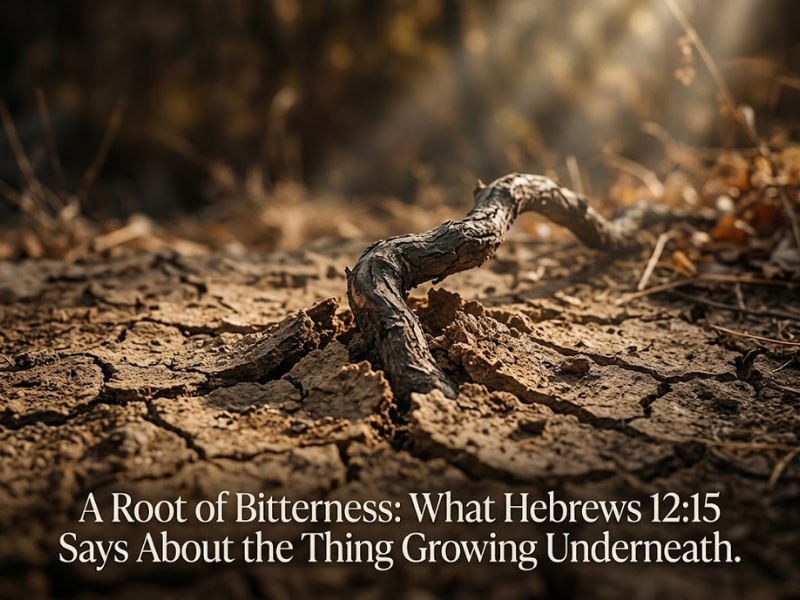
Key takeaways: Hebrews 12:15 warns of a “root of bitterness” — hidden, growing resentment planted by a real offense that, left unchecked, springs up to trouble you and defile many. Bitterness is not the hurt itself but what you do with it afterward. The way out: name it as sin, release the debt out loud by name, quit rehearsing the case, pray for the offender, and return good for evil.
Anybody who has owned an older house with a big tree out front knows what eventually happens to the sidewalk. For years nothing shows. The root runs along underneath doing quiet work nobody can see. Then one summer you notice the slab has lifted an inch on one corner, and by the next summer it has cracked clean through.
Now you can patch that concrete, and people do. But the patch will lift too, because the concrete was never the problem. Whatever fixes that sidewalk has to go down to the root.
The writer of Hebrews reaches for the same picture, and he is not talking about landscaping.
Hebrews 12:15 — “Looking diligently lest any man fail of the grace of God; lest any root of bitterness springing up trouble you, and thereby many be defiled.”
Well, here is what makes this particular sin so dangerous. Bitterness is the one almost nobody confesses, because it never feels like sin. It feels like accuracy.
Bitterness comes with evidence attached. There was a real offense. There is usually a real name, a real date, and a real thing that was said, and the man carrying it can produce the file at a moment’s notice. So when he examines himself, bitterness does not show up on the list. It has filed itself under something else — clear-eyed realism, or discernment about a person’s character.

What Does Hebrews 12:15 Mean by a “Root of Bitterness”?
The phrase describes a hidden and growing thing rather than a passing mood. It is planted by a real offense, fed by rehearsal, and it bears fruit long after the event that started it. And the verse hands the watching to the whole congregation rather than to the bitter man alone.
Start with the verse before it, because verse 15 is answering something:
Hebrews 12:14 — “Follow peace with all men, and holiness, without which no man shall see the Lord:”
Follow peace — and then verse 15 names the thing that makes peace impossible.
Now the phrase “looking diligently” is worth stopping on. The Greek is episkopountes, the verb behind the word “overseer.” Peter uses it in 1 Peter 5:2 for shepherding the flock of God. This is oversight language.
And notice who it is addressed to. It is plural. The writer is not telling the bitter man to watch himself; he is telling the church to watch for this — which says something about how well bitterness hides from the man carrying it.
The phrase itself is borrowed. The writer is reaching back to Moses:
Deuteronomy 29:18 — “Lest there should be among you man, or woman, or family, or tribe, whose heart turneth away… lest there should be among you a root that beareth gall and wormwood;”
Wormwood is a bitter plant, and gall is poison. And the danger Moses describes is not out among the nations. It is among you — inside the camp, in a family, in a tribe.
Why Does Bitterness Never Stay Personal?
Because the verse does not stop at “trouble you.” It ends at “and thereby many be defiled.” Bitterness needs corroboration in order to survive, so it goes looking for a sympathetic ear, and it usually finds one. What began as one man’s wound becomes a faction’s position.
Read that last clause again. Many be defiled. Not the bitter man alone — many.
Of course it works this way because bitterness cannot live in silence. A grievance kept to yourself starts to look thin after a while, so the man carrying it goes looking for somebody to confirm he is right. And there is almost always somebody willing.
Well, in a church that traffic has a well-worn route. It moves as a burden that needs sharing, as a prayer request with a name attached and just enough detail to make the case, and as a quiet word after the service — I don’t want to gossip, but you ought to know. The tongue is how the root spreads.
The same thing happens in families. A holiday table where somebody is not spoken to, an inheritance that settled an argument nobody will admit to having, and a grandchild who grows up knowing there is a branch of the family he does not meet. Nobody in that second generation was present for the offense. They inherited the defilement.
What Is the Difference Between Hurt and Bitterness?
Hurt is what was done to you. Bitterness is what you do with it afterward. Scripture never treats the wound itself as sin, and it never asks a wounded believer to pretend. The line gets crossed at rehearsal — at keeping the account open and going back to read it.
This has to be settled first, because a great deal of preaching on this subject leaves a wounded person feeling guilty for having been wounded.
Scripture does not do that. Look at how much room Paul leaves:
Ephesians 4:26-27 — “Be ye angry, and sin not: let not the sun go down upon your wrath: Neither give place to the devil.”
Be ye angry, and sin not. Anger at genuine wrong is not automatically sin — the Lord Jesus showed righteous indignation in the temple. Grief at being wronged is not sin either. He wept at a graveside, and He was betrayed by a friend and felt it.
So where is the line? It sits in the second half of the verse. Let not the sun go down. The trouble is not the anger arriving; it is the anger taking up residence, fed overnight and then over months, and given place. That word — place — is real estate language. Something is being handed a room.
Actually, that is where the line falls. Hurt happens to you. Bitterness is the decision, made over and over in small moments, to go back and read the file again.
What Does Scripture Require Us to Forgive — and What Doesn’t It?
Scripture requires you to release the debt. It does not require you to trust a man who has not changed, to restore a relationship the other party refuses to repair, to shield anybody from consequences, or to handle the justice yourself. These get collapsed into one thing constantly, and the confusion does real damage.
- Forgiveness is releasing the debt. “Forbearing one another, and forgiving one another, if any man have a quarrel against any: even as Christ forgave you, so also do ye” (Colossians 3:13). This is the part God commands, and it is settled between you and Him first.
- Reconciliation takes two. “If it be possible, as much as lieth in you, live peaceably with all men” (Romans 12:18). Two qualifiers in one short verse. Paul knew some relationships never get repaired, and he did not lay that failure on the person who tried.
- Trust is rebuilt, not owed. Nothing in Scripture requires handing a man back the thing he abused. Forgiving an embezzler does not mean putting him back on the books, and forgiving a violent man does not mean going back into the house with him. Trust is earned back over time, and asking for evidence of change is not bitterness.
- Consequences remain. When David repented, Nathan told him both halves. “The LORD also hath put away thy sin; thou shalt not die” (2 Samuel 12:13) — and the next verse told him what would still follow. Forgiveness settled the account. It did not erase the wreckage.
- Vengeance gets handed over, not dropped. “avenge not yourselves, but rather give place unto wrath: for it is written, Vengeance is mine; I will repay, saith the Lord” (Romans 12:19). God never says the debt does not matter. He says it is His to collect.
Now that last one is the pressure valve most people never open. Releasing a debt does not declare the offense unimportant. It transfers the case to a Judge who sees all of it, cannot be deceived, and will not let one ounce go unaddressed.
Do We Have to Forgive Someone Who Never Repented?
The New Testament says two things here, and both are true. The transaction between two people waits on repentance. The state of your own heart before God does not. You can release a man to God without ever being reconciled to him, and Scripture asks the first of you whether or not the second is possible.
Now here is where many of us get stuck, and it is a real tension in the text rather than a manufactured one. Jesus says this:
Luke 17:3 — “Take heed to yourselves: If thy brother trespass against thee, rebuke him; and if he repent, forgive him.”
If he repent. There is a condition sitting right there in the verse. But when Peter asks how many times he is obligated to do it, the Lord gives a number that is not really a number:
Matthew 18:21-22 — “…how oft shall my brother sin against me, and I forgive him? till seven times? Jesus saith unto him, I say not unto thee, Until seven times: but, Until seventy times seven.”
And then this one, with no condition attached at all:
Mark 11:25 — “And when ye stand praying, forgive, if ye have ought against any: that your Father also which is in heaven may forgive you your trespasses.”
So which is it? Many of us have sat with that question over one specific person — the parent who died without ever admitting what he did, the friend who moved away and never called, the man who is still telling his version to anybody who will listen. What do we owe somebody who never apologized and never will?
Well, both verses stand, because they are describing two different things.
Luke 17 governs a transaction between two people. Rebuke, repentance, restoration — that is the process for a relationship being put back together, and it does wait on the other man. Mark 11:25 governs something else. It is spoken to a man standing in prayer, and it concerns what he carries into the presence of God. That was never contingent on the other party.
Stephen settles it. He was being killed at the time.
Acts 7:60 — “And he kneeled down, and cried with a loud voice, Lord, lay not this sin to their charge…”
Nobody had repented. Nobody was going to. Stephen released them anyway, because what he was doing was between him and God.
Is Forgiveness Something We Do for Our Own Peace of Mind?
No, and that framing has quietly become the standard one. Forgiveness is commanded because God forgave us, and the pattern is His rather than ours. Peace usually follows, but it is the fruit and not the foundation, and a forgiveness built on the fruit will not hold when the feelings fail to arrive.
Well, we have all heard it put this way. Forgive him for your own sake. Bitterness is a poison you drink hoping the other man will die. Let it go, because you deserve peace.
Now some of that is true as far as it goes, and bitterness does eat a man alive. But look what happens to the verse when we frame it that way:
Ephesians 4:31-32 — “Let all bitterness, and wrath, and anger, and clamour, and evil speaking, be put away from you, with all malice: And be ye kind one to another, tenderhearted, forgiving one another, even as God for Christ’s sake hath forgiven you.”
That word “bitterness” is pikria, the same root the writer of Hebrews uses in 12:15. And notice where Paul grounds the command. Not in your wellbeing. Even as God for Christ’s sake hath forgiven you. The standard is God’s conduct toward you, and the motive is gratitude for it.
That distinction matters practically. If a man forgives for his own peace of mind, then on the day peace does not come — and there will be such days — the whole thing collapses. If he forgives because God forgave him, his obedience never depended on how he felt afterward.
There is a related move worth naming. Boundary language is useful, and Scripture supports much of it. But it also gets used to sanctify a permanent grudge — I’ve set a boundary, when the meaning is I have decided never to release this. A boundary limits access. It does not settle a debt.
Now there is a ditch on the other side of this road, and in churches it probably does more damage than the first. Cheap forgiveness rushes a wounded person. It shows up a week after something terrible, wearing a Bible verse, asking whether she has forgiven him yet — as though her grief were the sin under discussion. It collapses every category from the last section, so that forgiving comes to mean going back.
Job’s friends are the case study. They sat with him seven days and did well. Then they opened their mouths, and nearly everything they said made a suffering man worse.
That said, neither ditch is where Scripture stands. Colossians 3:13 asks for the real thing — forgiving one another, even as Christ forgave you — and Christ rushed nobody, nor did He pretend the debt was small.
How Do We Dig Up a Root That Is Already Deep?
A root that took years to grow does not come out in a single prayer. Scripture gives us the work: name it honestly, release the debt by name, quit rehearsing the case, pray for the man, return good for evil, and expect to do it more than once.
- Name it as sin, not as a grievance. “Search me, O God, and know my heart: try me, and know my thoughts: And see if there be any wicked way in me” (Psalm 139:23-24). Ask God to show you what you have been filing under another name. Most of us cannot see this one alone.
- Release the debt out loud, by name. Vague forgiveness forgives nobody. Say the name, say what was done, and say plainly that you are handing the account over to God.
- Quit rehearsing the case. Bitterness lives on retelling, and every time the story gets told the root gets watered. Decline to bring it up, decline to relitigate it at two in the morning, and refuse to recruit anybody to your side.
- Pray for him. “pray for them which despitefully use you, and persecute you” (Matthew 5:44). This is the hardest item on the list and the one that actually kills the root. It is difficult to keep hating a man you are steadily asking God to bless.
- Return good for evil. “Be not overcome of evil, but overcome evil with good” (Romans 12:21). That is an action rather than a feeling, and usually a small one.
- Expect to do it again. Forgiveness is often a decision made once and then held many times, as the memory keeps coming back. Having to hold it is not failure. Holding it is the work.
What If the Debt You Cannot Forgive Is Smaller Than the One You Owe?
Jesus told a story about a man forgiven an unpayable debt who then seized a fellowservant over a hundred days’ wages. The point is not that our injuries are trivial. It is that many people cannot forgive because they have never actually received forgiveness themselves.
In Matthew 18, a servant owes his king ten thousand talents — a sum no laborer could repay in many lifetimes. The king forgives all of it. And then:
Matthew 18:28 — “…the same servant went out, and found one of his fellowservants, which owed him an hundred pence: and he laid hands on him, and took him by the throat, saying, Pay me what thou owest.”
A hundred pence came to roughly a hundred days’ wages. A real debt, and not nothing. But set beside what he had just been released from, it was not worth a throat.
Matthew 18:35 — “So likewise shall my heavenly Father do also unto you, if ye from your hearts forgive not every one his brother their trespasses.”
Now this is where some ought to stop and be honest. If forgiving anybody at all feels impossible, it may be that forgiveness has never come the other direction. A man cannot pass along what he has never received.
Romans 10:9 — “That if thou shalt confess with thy mouth the Lord Jesus, and shalt believe in thine heart that God hath raised him from the dead, thou shalt be saved.”
Admit that you are a sinner. Believe that Jesus Christ died for your sins and rose again the third day. Call on Him and receive Him as your Saviour.
Romans 10:13 — “For whosoever shall call upon the name of the Lord shall be saved.”
Once that debt is settled, the other one starts to look a great deal smaller.
Father, search us and show us what we have been carrying and calling by another name. We hand You the debts we have held and the names attached to them, because You judge rightly and we do not. Pull up what has grown deep in us, however long it has been there. Make us kind and tenderhearted toward people who have not earned it, the way You have been toward us. In Jesus’ name, amen.
Visit the Daily Christian Living blog for more devotionals.
What is the root of bitterness in Hebrews 12:15?
A hidden, growing resentment planted by a real offense that, left unchecked, springs up to trouble you and defile many around you.
What is the difference between hurt and bitterness?
Hurt is what was done to you; bitterness is what you do with it afterward. Scripture never confuses the two.
Do I have to forgive someone who never repented?
Release the debt before God (Mark 11:25); reconciliation waits for repentance (Luke 17:3). Stephen forgave his killers who never repented (Acts 7:60).
How do I get rid of bitterness?
Name it as sin, release the debt out loud by name, quit rehearsing the case, pray for the offender (Matthew 5:44), and return good for evil (Romans 12:21).
Comments are closed