
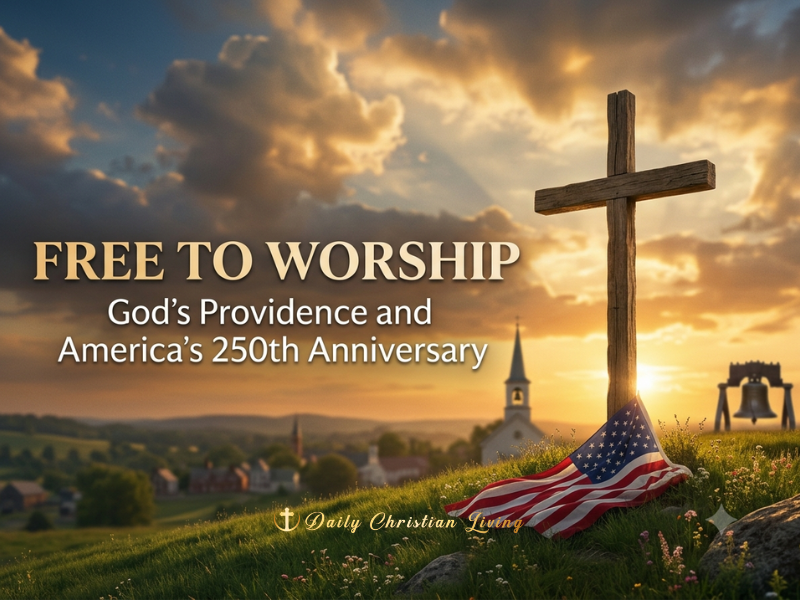
Key takeaways: Religious freedom — the freedom to worship God according to conscience — was not an accident of history but a gift of divine providence, as America’s 250th anniversary reminds us from the Pilgrims’ crossing to Caesar Rodney’s midnight ride to the fog at Long Island. Scripture teaches that God appoints the times and borders of nations (Acts 17:26), that the king’s heart is in the LORD’s hand (Proverbs 21:1), and that the liberty Christ purchased (Galatians 5:1) outlasts every empire. We steward this inheritance by praying for our nation, remembering the LORD (Deuteronomy 6:12), and trusting Christ for the freedom that matters most (John 8:36).
There’s an old danger in moving into a house you didn’t build. The lights already work, the roof keeps out the rain,
the well out back gives cold water on a hot day, and after a while, you stop thinking about any of it. You forget that somebody cleared the trees, hauled the stone, and lost sleep so you could flip a switch without a second thought. The blessing fades into the background, and that’s exactly when it’s in the most danger.
God warned His people about this very thing. As Israel stood on the edge of the Promised Land (a land of cities they had not built and wells they had not dug) the LORD told them plainly:
Deuteronomy 6:10-12 — “And it shall be, when the LORD thy God shall have brought thee into the land… to give thee great and goodly cities, which thou buildedst not, And houses full of all good things, which thou filledst not, and wells digged, which thou diggedst not… when thou shalt have eaten and be full; Then beware lest thou forget the LORD.”
Well, that is where the American Christian stands in 2026. This summer marks 250 years since 56 men signed the Declaration of Independence, and in doing so, signed their own death warrants if the cause failed.
We live in the house they built; we drink from the well they dug. And the warning rings down to us just as it rang to Israel: beware lest thou forget. Because this nation was no accident of clever politics and good luck.
From its first breath, it was bathed in providence, and the freedom we inherited (above all, the freedom to worship God without a king’s permission) was secured by a hand far stronger than any army. The only question worth asking on a day like this is whether we still remember whose hand it was.
What Were the Founders Really Fighting For?
Many of the men and women who settled this land and later shaped its founding crossed an ocean for one freedom above all others: the freedom to worship God according to conscience, with no king and no state church standing between them and their Bible. Political liberty mattered, and they bled for it. But underneath it ran a deeper conviction: that a man answers to God alone.
Now, the popular retelling likes to scrub this part out. You’ll hear it was all Enlightenment philosophy and tax disputes, with religion tacked on for flavor. But that’s not honest history.
The Pilgrims didn’t board the Mayflower for lower taxes. They crossed a brutal ocean, buried half their number that first winter, and clung to a rocky coastline because back home they were not free to worship as they believed Scripture commanded. That same hunger drove Puritans, Baptists, Quakers, and Huguenots here from the get-go.
That conviction worked its way into the nation’s founding charter. When Jefferson wrote that men are endowed by their Creator with certain unalienable rights, he was making a theological claim, not just a political one.
Rights come from God, not from government, and what government does not grant, it cannot rightly take away. So let’s be clear about what was really at stake: the founders prized civil liberty, but the freedom that ran deepest was the freedom to bow to God alone.
That said, we have to hold this carefully, because there’s a ditch on both sides of the road. On one side is the secular version that pretends God had nothing to do with any of it. On the other is a flag-waving that practically baptizes the nation, as if America were the church and patriotism were the gospel. It isn’t.
A country, however blessed, cannot save a single soul. The liberty Christ purchased on the cross is another category altogether: Stand fast therefore in the liberty wherewith Christ hath made us free, and be not entangled again with the yoke of bondage (Galatians 5:1). That freedom outlasts every empire. We can love our country and still keep first things first.
Was There Really a Miracle Behind the Declaration?
Yes—and one of the clearest is the midnight ride of Caesar Rodney. With Delaware’s three-man delegation split and the vote for independence hanging in the balance, a gravely ill delegate climbed onto a horse and rode roughly eighty miles through a July thunderstorm to break the tie. Without that ride, the colonies do not speak with one voice.
Here’s the situation Congress faced in early July 1776. Independence required the colonies to speak with one voice, and Delaware was a problem. Of her three delegates, Thomas McKean stood for independence, and George Read stood against, leaving the colony deadlocked. The third man, Caesar Rodney, was home in Kent County, and he was sick. He had been fighting cancer for years, and the eighty-mile ride to Philadelphia was no small thing for a healthy man, let alone a dying one.
When McKean got word that the vote was at hand and Delaware was split, he sent an urgent message south: come now. And Rodney went. On the night of July 1, he rode through thunder and pouring rain, hour after hour, covering in about eighteen hours a trip that normally took two days. He reached Independence Hall on July 2, still in his boots and spurs (muddy, soaked, and ill), just as the voting was getting underway. He cast Delaware’s vote for independence, and the resolution carried.
Now, some of us hear a story like that and a quiet voice pipes up: isn’t that just a coincidence? A summer storm, a stubborn old man, a fast horse—why drag God into it?
That’s a fair question, and it deserves an honest answer rather than a quick brush-off. We don’t want to slap the word “miracle” on every lucky break and cheapen it.
But here is what Scripture says about how God runs the affairs of nations. Proverbs 21:1 tells us, The king’s heart is in the hand of the LORD, as the rivers of water: he turneth it whithersoever he will. Daniel watched empires rise and fall and concluded that God removeth kings, and setteth up kings (Daniel 2:21). And on Mars’ hill, Paul told the philosophers that God hath determined the times before appointed, and the bounds of their habitation (Acts 17:26).
The times and the borders of nations are not an accident; they are appointed.
So we don’t need a parted sea to see the hand of God. More often than not, providence doesn’t arrive as fire from heaven; it shows up in ordinary means bent toward an extraordinary purpose: a shift in the weather, a willing man who could have stayed in his sickbed, a vote that fell one way instead of the other. Call it a coincidence if you like; the believer who knows his Bible sees the fingerprints of a God who works all things after the counsel of His own will.
How Did God Carry a Ragtag Army Through the War?
Declaring independence was one thing; surviving the war that followed was another. An untrained, underfed, often unpaid army had to make that declaration stick against the most powerful military on earth, and again and again, the impossible happened. A fog that hid a retreat. A winter endured. An ally arriving at the darkest moment.
If the Declaration was a miracle of timing, the Revolution was a whole string of them. Britain had the world’s finest navy, a professional army, and every material advantage; the colonists had conviction, an outmatched general, and little else. By every reasonable measure, they should have lost. Consider a handful of moments where the war turned on something no general could have arranged:
- The fog at Long Island. In August 1776, just weeks after independence was declared, Washington’s army was beaten badly on Long Island and pinned against the East River. Nine thousand men faced capture, and capture likely meant the end of the war. Their only escape was across the river by night—and as the evacuation began, a thick fog settled over the water and hid them from the British. They ferried every man across without losing a soldier, and when the fog lifted, the redcoats woke to empty positions. One soldier wrote that “providentially for us, a great fog arose.”
- A general preserved for a purpose. Two decades earlier, a young George Washington rode into the slaughter at the Battle of the Monongahela. When the smoke cleared, he had four bullet holes through his coat and two horses shot from under him—yet walked away without a scratch. He credited “the all-powerful dispensations of Providence.” It’s hard not to see a man kept alive for a job he hadn’t been handed yet.
- The winter at Valley Forge. The winter of 1777 and 1778 nearly broke the army. Bitter cold, empty stomachs, no shoes, sickness in the huts—more than two thousand men died without a battle being fought. And yet there was no mass mutiny and no collapse; the army that limped in marched out tempered and trained. Washington was known to slip away for private prayer in those months, convinced the cause depended on God’s help and not merely his own.
- An ally at the eleventh hour. After the American victory at Saratoga in 1777, France threw its weight behind the cause and signed a formal alliance in early 1778. French money, supplies, troops, and, importantly, a navy arrived at the very point the struggle most needed them. The timing could hardly have been better if it had been scripted.
Any one of these you might wave off as a fortunate break. But line them up (the fog, the survival, the winter, the alliance), and a pattern emerges that’s awfully hard to chalk up to luck. Washington didn’t try to. He called it Providence, and he was not a man given to easy religious talk.
What Did John Adams See Coming?
Writing to his wife, Abigail, on July 3, 1776, John Adams predicted that the day of independence would be celebrated for generations to come, but notice what came first in his mind. Before the parades and the fireworks, he said it ought to be marked “by solemn acts of devotion to God Almighty.” The founders saw independence as a deliverance, and deliverance calls for worship before it calls for a party.
Adams believed they had done something of lasting significance, and he was right—though he had the date slightly off, expecting the second of July to be remembered rather than the fourth. He told Abigail the day ought to be commemorated as the day of deliverance, by solemn acts of devotion to God Almighty. Then, and only then, he added that it ought to be “solemnized with Pomp and Parade, with Shews, Games, Sports, Guns, Bells, Bonfires and Illuminations from one end of this continent to the other.”
Notice the order. Devotion to God came first; the bonfires and the bells came second. The fireworks we set off every Fourth of July are, whether we realize it or not, the back half of a sentence that began with worship. Somewhere along the way, we kept the parade and quietly dropped the prayer.
And Adams was no starry-eyed optimist. In that same letter, he admitted he was “well aware of the toil and blood and treasure that it will cost us to maintain this Declaration.” He counted the cost with clear eyes and still concluded that the right response was to give thanks to God. A man who saw both the price and the providence knew exactly where the credit belonged.
What Are We Called to Steward Now?
We did not dig these wells. We inherited a freedom that was paid for in prayer and blood, and Scripture warns that the great danger of inherited blessing is forgetting the God who gave it. The call at two hundred and fifty years is not first of all political, it is spiritual. America’s deepest need is not a better party in power but a people willing to humble themselves and pray.
Which brings us right back to where we started, standing in a house we didn’t build. Remember the warning to Israel on the edge of that good land: when you have eaten, and you are full, then beware lest thou forget the LORD (Deuteronomy 6:12). That has always been the real threat to this nation. The danger was never only the army across the water or the rival across the aisle; the greatest danger is a people who enjoy the blessing and forget the One who gave it.
Ronald Reagan famously warned that freedom is never more than one generation from extinction—that it isn’t passed down in the bloodstream, but has to be fought for and handed on. He meant political liberty. But the warning cuts even deeper, turned toward spiritual things: a nation can lose its memory of God in a single generation that simply stops teaching its children to fear Him.
Now, here is where a lot of well-meaning Christians get it backwards. Looking at the moral mess around us, our first instinct is to reach for the ballot box, as though the right election could fix what’s broken at the root. Don’t misunderstand; voting matters, and Scripture tells us to honor the governing authorities (Romans 13:1). We should engage, and engage seriously. But politics is downstream from something deeper. You cannot legislate a nation into righteousness, and you cannot vote revival into existence. The problem is not finally political; it is spiritual, and it calls for a spiritual answer.
And God has already told us what that answer looks like. It is one of the most familiar verses in all of Scripture, and we would do well to take it at its word:
2 Chronicles 7:14 — “If my people, which are called by my name, shall humble themselves, and pray, and seek my face, and turn from their wicked ways; then will I hear from heaven, and will forgive their sin, and will heal their land.”
That word “heal” is the Hebrew rapha—the same root behind the name Jehovah-Rapha, the LORD that healeth thee (Exodus 15:26). God isn’t merely offering to patch up a damaged nation; He’s offering to restore it to health the way a physician mends a broken body. But notice where the condition lands. Not on the politicians, and not on the lost world, doing what lost people do. It lands on my people, which are called by my name. The healing of a land begins with the humbling of the church. Revival doesn’t start at the polls; it starts in the pew, then in the prayer closet, then in the home.
So what does it look like to steward this inheritance well? We pray for our nation instead of just arguing about it. We live holy in a culture that has forgotten how. We raise our children to know the Lord and not merely to wave the flag. And we use the freedom we still have to spread the gospel while the door stands open, because no one has promised it stays open forever.
And there is one last freedom to name, because it’s the one this whole story has been pointing to. The truest independence a person can know is not freedom from a king across an ocean—it is freedom from the tyranny of sin. All the providence of 1776, all the blood spilled at Valley Forge, cannot do for your soul what Jesus Christ did on the cross.
He said it plainly: If the Son therefore shall make you free, ye shall be free indeed (John 8:36). If you have never trusted Him, no earthly freedom you celebrate this week comes close to what He offers—pardon for your sin, peace with God, and a home in heaven no nation can give and no enemy can take. That is the declaration of independence worth signing, and you can settle it with Him today.
Father, we thank You for the freedom we did not earn and the providence that founded this land. Forgive us for enjoying Your blessings while forgetting You, and stir Your church to humble itself and seek Your face again. Help us to steward this inheritance well—praying for our nation, living holy before a watching world, and pointing our neighbors to the only freedom that truly lasts. And let us never forget that our deepest citizenship is in heaven, bought by the blood of Your Son. In Jesus’ name, amen.
What were the founders really fighting for?
The founders were fighting for religious freedom — the freedom to worship God according to conscience. The Pilgrims crossed the Atlantic to escape religious persecution, and that conviction shaped the Declaration of Independence, which declares that rights come from God, not government.
Was there really a miracle behind the Declaration?
Yes — Caesar Rodney’s midnight ride is one clear example. With Delaware’s delegation split, Rodney rode 80 miles through a thunderstorm to cast the tie-breaking vote for independence. Scripture teaches that ‘the king’s heart is in the hand of the LORD’ (Proverbs 21:1) and that God ‘determined the times before appointed, and the bounds of their habitation’ (Acts 17:26).
How did God carry a ragtag army through the war?
Through a string of providences: the fog at Long Island that hid Washington’s retreat, Washington’s miraculous survival at the Battle of Monongahela, endurance through the winter at Valley Forge, and France’s alliance after Saratoga. Any one might be waved off as luck, but together they reveal God’s hand.
What are we called to steward now?
We steward this inheritance by praying for our nation (2 Chronicles 7:14), remembering the LORD so we do not forget Him in prosperity (Deuteronomy 6:12), and trusting Christ for the freedom that matters most — ‘If the Son therefore shall make you free, ye shall be free indeed’ (John 8:36).
Comments are closed