
There is a quiet battle that wages inside every believer before the sun fully rises. You open your Bible with your mind still half-cluttered by yesterday’s worries and tomorrow’s to-do list, and you try to settle your heart before the Lord.
You want peace. You want joy. But something inside you keeps running ahead, grabbing for the reins, trying to figure out every angle before you have even finished your coffee.
King David understood this tension well. In Psalm chapter sixteen, he lays out a path that turns inner restlessness into rest. It is one of the most uplifting passages in all of Scripture, and it holds the secret to a joy that does not fade when Monday morning hits.
Psalm 16:11
Thou wilt shew me the path of life: in thy presence is fulness of joy; at thy right hand there are pleasures for evermore.
That is not just beautiful poetry. That is a promise for today, for this week, and for every year God gives you on this earth. But accessing it requires something most of us fight against every single morning: surrender.
What Does Psalm 16:11 Mean About the Path of Life?
Psalm 16:11 reveals three gifts God gives His children: a clear path to walk, a full presence to enjoy, and eternal pleasures at His right hand. David declared that life’s deepest satisfaction comes not from circumstances or accomplishments but from walking close to God Himself, step by step, moment by moment.
The Hebrew word translated “path” here is orach, which describes a well-worn road or the beaten course of a traveler. God is not handing His children a rough map with vague directions. He places us on a tested, traveled road that He Himself lights one step at a time. We do not need to see a mile ahead; we only need to see the next faithful step.
The word rendered “fulness” is sobah, carrying the idea of being satisfied to the point of fullness, like a hungry man after a good meal. This is not a sip of joy. This is a feast. And the table is set in His presence, a Hebrew phrase that reads literally “at Thy face.” To be in His presence is to have His face turned toward you in favor.
Finally, the “pleasures for evermore” uses the word netzach, meaning enduring, perpetual, unending. The world peddles pleasures that rust, break, or fade with time. God offers pleasures that will still be fresh a billion years into eternity.
Why Does Our Flesh Struggle to Rest in the Hope of Christ?
Our flesh resists rest because it craves control. It wants to see the whole picture, manage every outcome, and run ahead of God’s timing. Until we learn to release that grip, we cannot experience the rest David describes in Psalm 16:9, where even the body finds peace by trusting in God’s unseen plan.
Two verses earlier, David writes:
Psalm 16:9
Therefore my heart is glad, and my glory rejoiceth: my flesh also shall rest in hope.
That final phrase, “my flesh also shall rest in hope,” should stop us in our tracks. It is one thing for the spirit to rest. It is another thing entirely for the flesh to rest.
The flesh is not naturally restful. The older we get, the more we realize how weak our flesh actually is. We want to understand the whole picture. We want every angle covered. We want to be in control. But no matter how gifted or talented we are in our own strength, we eventually run out of road.
Many believers wrestle with this same struggle. The restless flesh shows up in familiar ways:
- Lying awake at night, running through scenarios that may never happen
- Trying to manipulate outcomes that only God can arrange
- Refusing to take the next step until every variable is known
- Feeling anxiety rise the moment God’s timing does not match ours
The Hebrew word for “rest” in Psalm 16:9 is shakan, the same root from which we get Shekinah, the dwelling glory of God. Our flesh finds true rest only when it stops striving and settles down inside the shelter of God’s presence. The prophet Isaiah put it this way:
Isaiah 26:3
Thou wilt keep him in perfect peace, whose mind is stayed on thee: because he trusteth in thee.
What Did the Apostle Paul Mean by “I Die Daily”?
When Paul wrote “I die daily” in 1 Corinthians 15:31, he described the daily, deliberate act of surrendering his own will, plans, and fleshly desires to the Lord. It is the pattern of every growing believer: a morning-by-morning choice to trust Christ rather than self, trading the exhausting work of self-rule for the peace of God’s rule.
The Apostle Paul knew the struggle of the flesh better than most. He wrote to the Corinthians:
1 Corinthians 15:31
I protest by your rejoicing which I have in Christ Jesus our Lord, I die daily.
The Greek word for “die” here is apothnesko, an intensified form meaning “to die off” or “to die away from” something. This is not a slow fading. It is a deliberate putting off. Paul described a daily crucifixion of the self-life so that the Christ-life could come through.
He echoed the same truth to the Galatians:
Galatians 2:20
I am crucified with Christ: nevertheless I live; yet not I, but Christ liveth in me: and the life which I now live in the flesh I live by the faith of the Son of God, who loved me, and gave himself for me.
Dying daily is not morbid, and it does not have to be painful. It means:
- Resting in His hope rather than scheming in your own strength
- Submitting to His will when you cannot trace His plan
- Surrendering the need to understand every detail
- Trusting that His timing is never too early and never too late
The Lord Jesus Himself gave us the pattern:
Luke 9:23
And he said to them all, If any man will come after me, let him deny himself, and take up his cross daily, and follow me.
Daily. Not once at salvation and then on spiritual autopilot. Every morning calls for a fresh surrender.
How Does Dying Daily Lead to Deeper Joy in Christ?
Dying daily leads to deeper joy because every surrender makes more room for Christ to fill our lives with Himself. The more we trade restless self-rule for His perfect peace, the more His presence becomes the anchor of our joy, and we discover that the longer we walk with Him, the sweeter He truly grows.
There is an old gospel hymn titled “The Longer I Serve Him” that captures a truth every maturing Christian eventually discovers: the Savior gets sweeter with every passing year. That sweetness is not because God changes. He never changes.
Malachi 3:6
For I am the LORD, I change not; therefore ye sons of Jacob are not consumed.
What changes is us. As we die daily, as we keep laying the flesh down, we gain a deeper taste of who He has always been. The restless believer barely sips what God wants to pour out. The surrendered believer drinks deeply.
This is exactly what David was after in Psalm sixteen. His gladness in verse nine was not shallow. His rejoicing was not manufactured. His flesh found rest because he had already settled the question of who was in charge. Because of that settled surrender, the joy in verse eleven became “fulness” rather than a trickle.
Notice how the pattern unfolds:
- Surrender your will in the morning (die daily)
- Trust God’s plan for what you cannot yet see
- Rest your flesh in hope, not in anxiety
- Walk the path He shows one step at a time
- Discover fulness of joy in His presence
Every step of obedience loosens the grip of the flesh and tightens the grip of grace. That is how the joy deepens. That is how the Savior grows sweeter with every passing year.
What Practical Habits Help Us Rest in God’s Hope Today?
Resting in God’s hope is built through small, repeated habits that return our hearts to Him throughout the day. These include morning surrender, Scripture meditation, honest prayer, and the deliberate choice to trust God’s sovereignty rather than our own striving. Consistency matters more than intensity, and the Lord honors the smallest step of genuine faith.
Practical Christianity is not complicated, but it does require intentional effort. Consider how you might put this into practice this week:
- Start each morning with surrender. Before your feet hit the floor, pray, “Lord, today is Yours. I do not need to see the whole picture. I only need to rest in Your hope.”
- Meditate on one verse at a time. Rushing through chapters rarely changes hearts. Sitting quietly with Psalm 16:11 for ten minutes often does.
- Name the thing you are gripping too tightly. Is it a financial decision? A wayward child? A career path? An unanswered prayer? Lay it before Him by name.
- Refuse to run ahead of God’s timing. Waiting is not wasted time. It is training time.
- Close each day with thanksgiving. Count the evidence of God’s goodness before sleep, even the small ones.
The Apostle Paul gave us the clearest prescription for a restless heart:
Philippians 4:6-7
Be careful for nothing; but in every thing by prayer and supplication with thanksgiving let your requests be made known unto God. And the peace of God, which passeth all understanding, shall keep your hearts and minds through Christ Jesus.
That peace is not earned. It is received by a surrendered heart.
Why Is God’s Presence the Only Source of Eternal Joy?
God’s presence is the only source of eternal joy because every lesser fountain eventually runs dry. Achievements fade, relationships shift, health declines, and possessions break. But the joy found at God’s right hand is unending because it flows from the unchanging nature of God Himself, who is the source and sustainer of all genuine pleasure.
The world is full of pleasure peddlers, each one promising joy if you will just buy their product, follow their program, or chase their version of success. But every one of those paths leads to the same disappointing end: a moment of satisfaction followed by a fresh craving.
King Solomon tried every pleasure under the sun. He built, he bought, he tasted, he experimented. His conclusion was sobering:
Ecclesiastes 2:11
Then I looked on all the works that my hands had wrought, and on the labour that I had laboured to do: and, behold, all was vanity and vexation of spirit, and there was no profit under the sun.
David found what Solomon missed. The path of life does not lead to a pile of accomplishments. It leads to a Person. “In thy presence is fulness of joy.” The joy is not beside Him. It is not beyond Him. The joy is Him.
The Lord Jesus declared this same truth to His disciples in the upper room:
John 15:11
These things have I spoken unto you, that my joy might remain in you, and that your joy might be full.
His joy becomes our joy. That joy does not evaporate when the trial comes, when the diagnosis arrives, when the finances tighten, or when the years pile up. It deepens. A heart anchored in His presence has pleasures forevermore, both in this life and in the life to come.
Walking the Path with a Quieted Heart
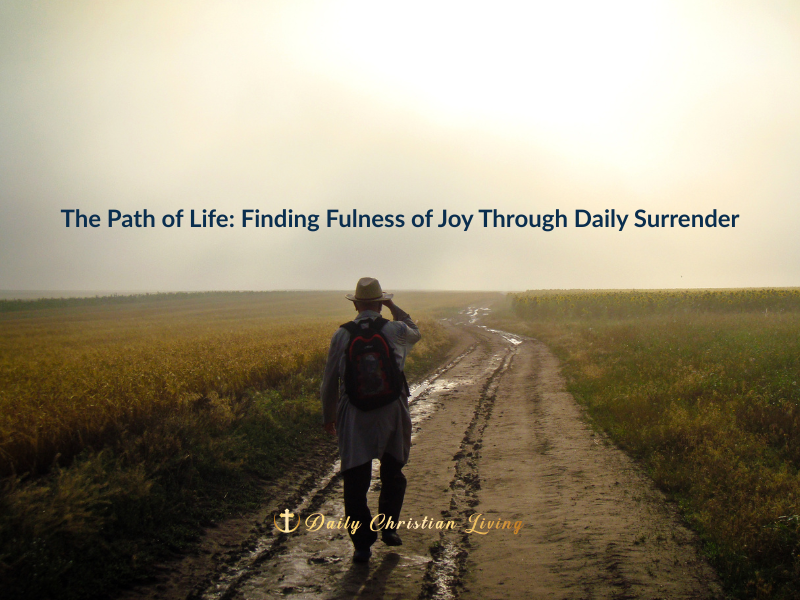
The flesh will keep fighting for the driver’s seat. That is the reality of living in a fallen body on this side of heaven. But every day you choose to die to self, you gain a little more of Him. Every day you rest in His hope, the path ahead looks a little less foggy. Every day you surrender, the joy grows fuller.
David’s invitation in Psalm sixteen is as fresh today as it was three thousand years ago. The path is still there. The presence is still available. The pleasures are still everlasting. You do not need a perfect Bible reading plan or a seminary degree to access them. You need a surrendered heart that is willing to say, “Lord, I trust You with today.”
Anchor your morning in Psalm 16:11 this week. Let it be your compass when the restlessness rises. The Lord of glory has already shown you the path of life, and He is waiting to walk it with you.
Father, thank You for the path of life that leads straight to Your presence. Teach us to die daily, to lay down our plans, our worries, and our need for control. Let our flesh rest in Your hope, even when we cannot see the whole picture. Fill us afresh with the fulness of joy that comes only from walking close to You, and remind us again and again that the pleasures at Your right hand will never fade. In Jesus’ name, Amen.
Comments are closed