
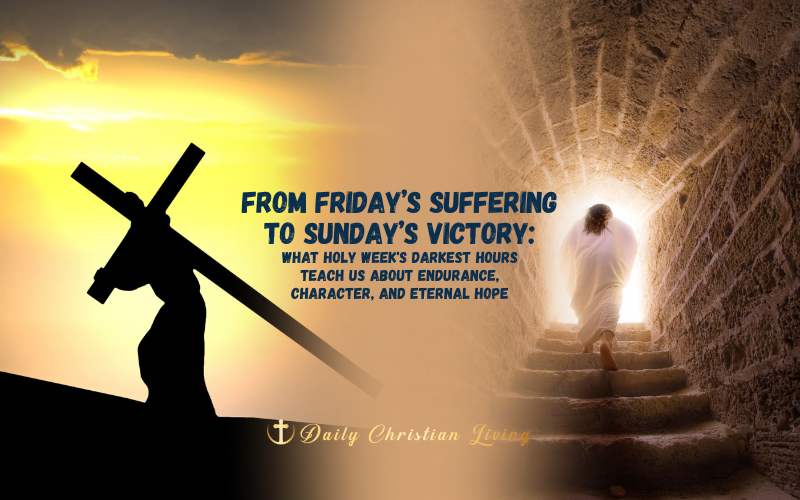
Every year, Holy Week confronts us with the most dramatic three-day sequence in human history. On Friday, the Son of God hung bleeding on a Roman cross while the sky turned black at midday. On Saturday, a sealed tomb held the lifeless body of the One who called Himself the Resurrection and the Life. On Sunday morning, an empty grave and a folded napkin announced that death itself had been defeated.
These three days are not merely historical events to be commemorated once a year. They are the living pattern through which God transforms every believer’s suffering into unshakable hope.
What makes this pattern even more remarkable is that the Apostle Paul captured its entire progression in a single passage. In Romans 5:1–5, Paul traces a chain that begins with peace, moves through tribulation and patience, and arrives at a hope that never disappoints—precisely the journey from Friday’s cross through Saturday’s silence to Sunday’s sunrise.
Whether you are walking through your own season of suffering, waiting in silence, or standing on the edge of a breakthrough, this passage and the Holy Week narrative it mirrors have something vital to say to all of us.
What Did Good Friday’s Cross Accomplish for Every Believer?
Good Friday’s cross accomplished what no human effort ever could: it paid the full penalty for sin, secured eternal peace with God, and opened the way for every believer to stand in grace. The suffering of Christ was not a tragedy that spiraled out of control; it was the predetermined plan of a sovereign God who loved the world enough to sacrifice His own Son in our place.
The prophet Isaiah described this substitutionary sacrifice centuries before it happened. Isaiah 53:5 declares:
“But he was wounded for our transgressions, he was bruised for our iniquities: the chastisement of our peace was upon him; and with his stripes we are healed.”
Notice the possessive pronouns: our transgressions, our iniquities, our peace. Every wound Christ received was a wound we deserved. The Hebrew word for “wounded” is chalal, meaning to be pierced through or fatally wounded—a mortal blow absorbed by the sinless Lamb of God on behalf of guilty sinners.
On the cross, two remarkable statements reveal the scope of what was accomplished. First, Jesus turned to a dying thief—a man with no religious resume, no time to reform, no works to offer—and made a promise that still echoes through the centuries. Luke 23:43 records: “And Jesus said unto him, Verily I say unto thee, To day shalt thou be with me in paradise.” Forgiveness was extended in the very moment of Christ’s agony. Grace does not wait for us to clean ourselves up; it meets us in our worst hour.
Second, just before He gave up the ghost, Jesus declared, “It is finished” (John 19:30). The Greek word here is tetelestai, a term used in ancient commerce that meant “paid in full.” When a debt was settled completely, this word was stamped across the account. Jesus was not merely announcing the end of His life; He was declaring that the sin-debt of every believer had been paid in full. There is nothing left to pay, nothing left to earn, nothing left to add.
This is why Paul can open Romans 5 with such confidence. Romans 5:1–2 proclaims:
“Therefore being justified by faith, we have peace with God through our Lord Jesus Christ: By whom also we have access by faith into this grace wherein we stand, and rejoice in hope of the glory of God.”
Peace with God is not something we achieve; it is something Christ purchased on Good Friday. The cross that looked like defeat was the greatest victory in the history of the universe. And that victory becomes the foundation upon which everything else—patience, character, hope—is built.
Why Is Holy Saturday’s Silence So Important for the Christian Life?
Holy Saturday matters because it teaches believers that God’s greatest work often happens in seasons of apparent silence. The space between the cross and the empty tomb is where faith is refined, patience is forged, and character is proven—even when heaven seems completely quiet.
Saturday is the forgotten day of Holy Week. We preach the cross on Friday and celebrate the resurrection on Sunday, but we rarely talk about the day in between. Yet for the disciples, Saturday was the longest day of their lives. The tomb was sealed. Roman soldiers stood guard. The One they had left everything to follow was dead, and the world felt as though it had simply… stopped.
No angels appeared. No voice thundered from heaven. Just silence. And in that silence, every doubt the disciples had ever suppressed must have come roaring to the surface: Was He really the Messiah? Did we waste three years of our lives? What do we do now?
This is the season many believers find themselves in right now. You have prayed, and heaven is quiet. You have obeyed, and nothing seems to change. You are waiting for a prodigal to come home, for a diagnosis to turn, for a door to open—and God appears silent. The Psalmist captures this cry in Psalm 13:1–2:
“How long wilt thou forget me, O LORD? for ever? how long wilt thou hide thy face from me? How long shall I take counsel in my own soul, having sorrow in my heart daily? how long shall mine enemy be exalted over me?”
But here is what Saturday teaches us: God’s silence is not God’s absence. Between the cross and the resurrection, the most important transaction in history was being finalized. God was not inactive; He was holding the universe in place while the full weight of redemption settled into reality.
Romans 8:28 assures us, “And we know that all things work together for good to them that love God, to them who are the called according to his purpose.” That promise is operative even—especially—in the quiet seasons.
Paul connects this directly to the progression of faith in Romans 5:3–4:
“And not only so, but we glory in tribulations also: knowing that tribulation worketh patience; And patience, experience; and experience, hope.”
The Greek word for “tribulation” is thlipsis, which literally refers to pressing or crushing—like olives pressed to produce oil or grapes crushed to produce wine. The pressure you feel in your Saturday season is not destroying you; it is producing something valuable that could not exist without the pressing.
That pressing produces hupomone, translated “patience” in the KJV but meaning far more than passive waiting. It describes the active endurance of a soldier who remains at his post under fire—the quality of remaining steadfast under pressure rather than running away. Saturday is where hupomone is forged in the furnace of faith.
And patience, in turn, produces “experience”—the Greek word dokime, which refers to the proven quality of metal that has passed through fire and been found genuine. A faith that has never been tested is a faith that has never been proven. Saturday is God’s refining fire, and the character that emerges is pure gold.
If you are in a Saturday season, take heart. The Psalmist reminds us in Psalm 30:5, “Weeping may endure for a night, but joy cometh in the morning.”
Your Saturday night is real, but it is not final. Morning is coming.
What Does the Empty Tomb Mean for Our Daily Hope?
The empty tomb means that the hope believers carry is not wishful thinking but verified, historical, resurrection-powered certainty. Because Christ rose from the dead, every promise God has ever made is guaranteed, every prayer is heard, and every trial has an expiration date.
After the darkness of Friday and the silence of Saturday, Sunday morning erupted with the greatest news the world has ever received. The stone was rolled away—not to let Jesus out, but to let the witnesses in. The angel’s declaration in Matthew 28:6 still thunders across the centuries: “He is not here: for he is risen, as he said. Come, see the place where the Lord lay.”
Mary Magdalene, who had stood weeping at the cross on Friday and waited in grief through Saturday, was among the first to see the risen Lord. Her testimony in John 20:18 is electrifying: “I have seen the Lord.” Four words that changed everything. The One who was dead is alive. The tomb is empty. Death has lost its grip.
Paul understood the cosmic significance of this event. In 1 Corinthians 15:20, he writes, “But now is Christ risen from the dead, and become the firstfruits of them that slept.”
The term “firstfruits” is an agricultural image from the Old Testament. The firstfruits offering was the initial portion of the harvest, presented to God as a guarantee that the full harvest was coming. Christ’s resurrection is God’s guarantee that every believer will also rise. His empty tomb is the down payment on our eternal life.
This is where the chain in Romans 5 reaches its glorious conclusion. Romans 5:5 declares:
“And hope maketh not ashamed; because the love of God is shed abroad in our hearts by the Holy Ghost which is given unto us.”
The hope that Paul describes is not a fragile, fingers-crossed optimism. It is a hope anchored in the empty tomb, sealed by the Holy Spirit, and proven by the love of God poured into our hearts. The phrase “shed abroad” translates the Greek ekcheo, which means to pour out lavishly, like water gushing from a broken dam. God’s love is not rationed in cautious drops; it is poured out in a flood through the indwelling Holy Spirit.
This is Sunday’s gift: a hope that will never put us to shame, because it rests on the accomplished, resurrection-sealed love of God. The author of Hebrews captures this in Hebrews 12:2: “Looking unto Jesus the author and finisher of our faith; who for the joy that was set before him endured the cross, despising the shame, and is set down at the right hand of the throne of God.”
Even while enduring Friday’s agony, Jesus could see Sunday’s joy. And because He endured, we can too.
How Does Romans 5:1–5 Mirror the Entire Holy Week Narrative?
Romans 5:1–5 mirrors Holy Week by following the same progression from suffering to peace to unshakable hope, revealing that the Easter narrative is not just history but a theological blueprint for every believer’s journey through trial to triumph.
When you lay these two narratives side by side, the parallels are striking:
- Peace with God (Romans 5:1) corresponds to Friday’s atonement. The cross settled the war between sinful humanity and a holy God. Justification by faith gives us peace—not a ceasefire, but a permanent treaty signed in the blood of Christ.
- Rejoicing in hope of glory (Romans 5:2) corresponds to Sunday’s resurrection promise. We stand in grace and look forward to the full manifestation of God’s glory because the empty tomb guarantees it.
- Glorying in tribulations (Romans 5:3) corresponds to Friday’s cross embraced. Just as Christ’s suffering was purposeful and redemptive, our tribulations are not random—they are the raw material God uses to produce something eternal.
- Tribulation → patience → experience → hope (Romans 5:3–4) corresponds to Saturday’s refining process. The silence between the cross and the resurrection is where endurance is tested, character is proven, and hope takes root.
- Hope that does not disappoint because of the Holy Spirit’s love (Romans 5:5) corresponds to Easter’s indwelling assurance. The same Spirit who raised Christ from the dead now lives inside every believer, pouring out God’s love as the seal of our hope.
Paul may not have consciously structured Romans 5 around the Easter timeline. But the Holy Spirit, who inspired every word of Scripture, wove the pattern into perfect parallel. The God who orchestrated the events of Holy Week is the same God who guided Paul’s pen. The pattern is consistent because the Author is consistent.
Paul reinforces this in 2 Corinthians 4:17: “For our light affliction, which is but for a moment, worketh for us a far more exceeding and eternal weight of glory.” The Friday–Saturday–Sunday pattern is not a one-time event in Jerusalem; it is the recurring rhythm of the Christian life. Every affliction is “light” and “for a moment” when measured against the “eternal weight of glory” that it produces.
How Can Believers Apply These Truths Beyond the Easter Season?
Believers can carry these truths beyond Easter by recognizing that the Friday–Saturday–Sunday pattern is the ongoing rhythm of the Christian life. Every season of suffering, every stretch of silence, and every breakthrough of hope follows the same pattern God established in Holy Week.
Here are practical ways to anchor your soul in these realities:
- Meditate on Romans 5:1–5 daily during Holy Week and beyond. Take one phrase each day—peace, grace, tribulation, patience, experience, hope, love—and ask God to make it real in your life. Let these words move from your head to your heart.
- Identify your current season. Are you in a Friday, enduring the raw pain of a fresh wound? A Saturday, waiting in silence for God to move? Or a Sunday, celebrating a breakthrough? Knowing where you are helps you trust the process. If you are in a Friday or Saturday, Sunday is coming.
- Journal God’s faithfulness. Write down the times God brought you through a “Friday” and into a “Sunday.” When the next trial comes, these recorded testimonies become ammunition against doubt and despair.
- Share the hope of the empty tomb. Someone in your life is stuck in a Saturday season right now. They need to hear that the tomb is empty, that hope is real, and that God’s silence does not mean God’s absence. Be the voice that points them to the risen Christ.
The Christian life is a marathon, not a sprint. There will be Fridays that leave you breathless and Saturdays that feel endless. But the same God who turned the darkest Friday in history into the most glorious Sunday morning is at work in your life right now.
Romans 5:2 says we “rejoice in hope of the glory of God.”
Not in hope of easier circumstances. Not in hope of a pain-free life. But in hope of the glory of God—the same glory that blazed from the empty tomb on Easter morning.
So rejoice—not because the trial is over, but because the victory is already sealed. The cross looked like loss, Saturday felt like abandonment, but Sunday proved that God’s plan wins. And because He rose, we will too.
Let us close with this prayer: Father, thank You for the cross that purchased our peace, for the silence that refined our faith, and for the empty tomb that sealed our hope. When we face our own Fridays and Saturdays, remind us that Sunday is coming. Pour Your love into our hearts afresh through the Holy Spirit, and give us the endurance to trust You in every season. In the precious name of our risen Savior, Jesus Christ, Amen.
Comments are closed