
Easter Sunday has come and gone. The resurrection hymns have faded, the lilies on the altar have begun to wilt, and the ordinary rhythms of life have resumed their steady march. For many believers, a quiet deflation sets in during the days after Easter.
The mountaintop experience of celebrating the risen Christ gives way to Monday morning: bills to pay, relationships to navigate, and prayers that still seem unanswered. If you have ever felt that strange letdown in the week following Resurrection Sunday, you are in ancient and honored company.
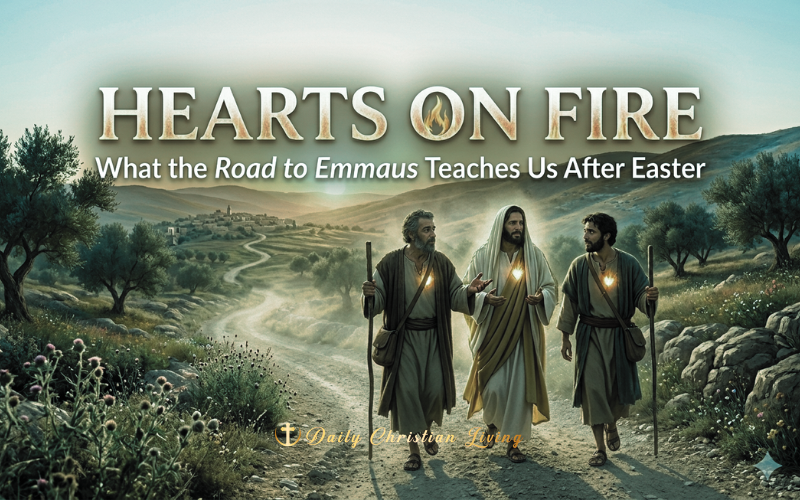
Two of Christ’s followers experienced that very deflation on the afternoon of the first Easter. In Luke 24:13–35, we encounter two disciples walking the seven-mile road from Jerusalem to the village of Emmaus. Their hopes had been shattered by the crucifixion, and rumors of an empty tomb seemed too strange to believe.
So they did what many of us do when faith falters; they headed home, away from the community of believers, walking in the wrong direction.
What happened on that dusty road changed everything. Jesus Himself drew near and walked with them, opened the Scriptures to them, revealed Himself in the breaking of bread, and set their hearts ablaze. Their experience offers believers a timeless blueprint for encountering the living Christ long after the Easter celebrations have ended.
Why Were Their Eyes Closed to the Risen Christ?
The two Emmaus disciples could not recognize Jesus because grief and shattered expectations had blinded them to His presence. Their story reveals a pattern common to every generation of believers: when we fix our eyes on our disappointment rather than on God’s promises, we lose the ability to perceive Christ walking right beside us. Recognizing Him requires a shift from despair to deliberate faith.
Luke 24:15–16
“And it came to pass, that, while they communed together and reasoned, Jesus himself drew near, and went with them. But their eyes were holden that they should not know him.”
The phrase “their eyes were holden” translates the Greek ekratounthsan (krateo in the passive voice), a word that means to seize, restrain, or hold fast. Their spiritual perception was being gripped by something stronger than their physical sight. Luke does not say they were blind; he says they were held. Grief, confusion, and unmet expectations had wrapped around their hearts like a fist, squeezing shut the eyes of faith.
These two had walked with Jesus during His earthly ministry—they had witnessed miracles, heard parables, and shared meals with the Master. Yet with the risen Lord striding alongside them, they saw only a stranger. Their tragedy was not a lack of information but a failure of perception caused by misplaced hope. They had expected a political deliverer who would overthrow Rome.
When the cross destroyed that expectation, their framework for understanding God collapsed with it. We are often no different.
We come to God convinced we know what His intervention should look like, and when He does not follow our outline, we assume He has gone silent—walking our own road to Emmaus, convinced the Lord is absent when He is closer than our next breath.
Psalm 34:18
“The LORD is nigh unto them that are of a broken heart; and saveth such as be of a contrite spirit.”
The beauty of the Emmaus account is that Jesus did not wait for their faith to recover before showing up. He initiated the encounter. He drew near to disappointed, confused, retreating disciples—not because they were strong, but precisely because they were weak. He meets us in the mess, not on the mountaintop.
How Does Jesus Reveal Himself Through Scripture?
Jesus opened the disciples’ understanding by walking them through the entire Old Testament and showing how every page pointed to Himself. He revealed that the Bible is not merely a collection of history and moral instruction—it is a unified testimony of the Messiah. When we approach Scripture prayerfully and consistently, the Holy Spirit continues to unveil fresh layers of Christ in passages we have read a hundred times before.
Luke 24:25–27
“Then he said unto them, O fools, and slow of heart to believe all that the prophets have spoken: Ought not Christ to have suffered these things, and to enter into his glory? And beginning at Moses and all the prophets, he expounded unto them in all the scriptures the things concerning himself.”
The word “expounded” here is the Greek diermeneuo, from which we derive the English word “hermeneutics”—the science of interpretation. Jesus gave the first and greatest Bible study in history. He did not merely quote isolated verses; He traced a thread from Genesis through the Prophets, showing how the sacrificial system, the Passover lamb, the suffering servant of Isaiah, and the promises of a coming King all converged in one Person. He connected every shadow to the substance it pointed toward.
Think of the ground He must have covered in that seven-mile walk. Perhaps He began with Genesis 3:15, the first whisper of the gospel. Perhaps He moved to Genesis 22, where Abraham raised the knife over Isaac on Mount Moriah—the very mountain range where Jesus would be crucified centuries later. He almost certainly opened Isaiah 53, where the Suffering Servant was “wounded for our transgressions” and “bruised for our iniquities.”
Every one of these passages had been available to those disciples their entire lives. Yet they had never seen what Jesus showed them. The same happens to believers today—you read a familiar passage, and suddenly a phrase leaps off the page with new meaning.
Psalm 119:18
“Open thou mine eyes, that I may behold wondrous things out of thy law.”
This is not a coincidence—it is the ministry of the Holy Spirit doing in us what Jesus did on that road:
Hebrews 4:12
“For the word of God is quick, and powerful, and sharper than any twoedged sword, piercing even to the dividing asunder of soul and spirit, and of the joints and marrow, and is a discerner of the thoughts and intents of the heart.”
The word “quick” is the Greek zon, meaning alive, living, breathing. Scripture is not a static document preserved under glass—it is the very breath of God. Every time we open it with a willing heart, He unveils something about His Son that we have never noticed before.
The Emmaus road teaches us that sustained, prayerful engagement with the Word is the primary channel through which Jesus reveals Himself to His people.
Where Does Jesus Show Up in the Ordinary?
Jesus chose an ordinary supper table—not a miracle or a heavenly vision—as the moment to open the disciples’ eyes. He revealed Himself in the breaking of bread, an act so commonplace that it could have been overlooked entirely. This teaches us that Christ often makes Himself known not through the spectacular but through the simple, sacred rhythms of daily life: communion, fellowship, prayer, and worship.
Luke 24:30–31
“And it came to pass, as he sat at meat with them, he took bread, and blessed it, and brake, and gave to them. And their eyes were opened, and they knew him; and he vanished out of their sight.”
Notice the deliberate echoes of the Last Supper in the upper room. “He took bread, and blessed it, and brake, and gave.” These are the same four verbs Luke uses to describe Jesus’ actions at the Passover table just days earlier. The disciples would have recognized those hands—perhaps even the nail prints in them—and that familiar sequence of taking, blessing, breaking, and giving. In an instant, the stranger became the Savior.
The Greek phrase “their eyes were opened” (dienoichthesan hoi ophthalmoi) uses the same language found in Genesis 3:7 in the Septuagint, where Adam and Eve’s eyes were opened to see their sin after the fall. On the Emmaus road, Christ reverses the curse. Where the first opening of eyes brought shame and separation, this opening brought recognition and reunion.
We often wait for God to show up in dramatic fashion—a miraculous healing, a financial windfall, or an audible voice from heaven. But the Emmaus account reminds us that He more often reveals Himself in quiet, ordinary moments:
- In the Lord’s Supper, where the bread and cup declare His death until He comes again. Every time your church observes communion, you are sitting at the Emmaus table.
- In Christian fellowship, where believers gather around a meal, share their burdens, and encourage one another in the faith. A conversation over coffee with a brother or sister in Christ can become holy ground.
- In private prayer, where the noise of the world falls away and the still, small voice of the Spirit speaks directly to the heart.
- In acts of service, where we see the face of Christ in the needs of others and encounter His presence as we pour ourselves out for His sake.
Jesus vanished the moment they recognized Him—not to abandon them, but to teach them that His presence would no longer depend on physical sight. He was preparing them for a faith that walks by the Spirit rather than by the eyes:
2 Corinthians 5:7
“For we walk by faith, not by sight.”
What Happens When Our Hearts Catch Fire?
When the two disciples recognized Jesus, they immediately recalled that their hearts had been burning within them as He taught from Scripture on the road. That internal fire became the catalyst for urgent, outward action—they ran back to Jerusalem to share the news. A genuine encounter with the risen Christ always produces both an inner transformation and an irresistible compulsion to tell others what we have seen and heard.
Luke 24:32–33
“And they said one to another, Did not our heart burn within us, while he talked with us by the way, and while he opened to us the scriptures? And they rose up the same hour, and returned to Jerusalem, and found the eleven gathered together, and them that were with them.”
The word “burn” here is the Greek kaiomene, meaning to be set on fire, to be ablaze. It describes more than a warm feeling—it speaks of a consuming flame that cannot be contained. The disciples’ hearts had been kindled by the Word of God, and once their eyes were opened, that smoldering fire burst into full blaze.
Consider what happened next. These two had just walked seven miles. It was evening, likely dark. The Judean roads were dangerous after sundown. They were tired and had just sat down to eat. Every practical consideration argued against traveling back. Yet “they rose up the same hour.”
They did not wait until morning or send a message. They ran back to Jerusalem because a heart set ablaze by the risen Christ cannot sit still. The urgency of the gospel overrides comfort, caution, and convenience.
This pattern repeats throughout Scripture. The Samaritan woman left her waterpot and ran to tell her village (John 4:28–29). Andrew found his brother Peter and brought him to Jesus (John 1:40–42). Paul, converted on the Damascus road, immediately began preaching Christ in the synagogues (Acts 9:20). An encounter with Jesus always produces witnesses.
Acts 4:20
“For we cannot but speak the things which we have seen and heard.”
This is the natural overflow of a burning heart. Faith was never designed to be a private possession locked away in the inner chambers of the soul. It is fire, and fire spreads. If your faith has grown cold in the days after Easter, perhaps the remedy is not more information but a fresh encounter—returning to the Word, sitting at the Lord’s table, and asking the Spirit to open your eyes again.
How Do We Walk the Emmaus Road Today?
The Emmaus road was not a one-time event sealed in the first century. It is a pattern Christ continues to follow with every generation of His people. He still draws near to disappointed hearts, still opens the Scriptures, still reveals Himself in the bread and cup, and still sends burning hearts into the world as His witnesses. The application for the modern believer flows directly from the four movements of the Emmaus narrative.
- Expect His presence in your lowest moments. Jesus did not appear to triumphant warriors—He joined grieving, retreating disciples. When you are walking through darkness, do not assume God has abandoned you. He has a pattern of showing up precisely when hope is hardest to hold. Stay connected to the body of Christ, because He often reveals Himself through the fellowship of other believers.
- Make daily Scripture reading an act of worship, not a chore. The Emmaus disciples had the Old Testament available for years, yet they needed Jesus to open its meaning. Pray Psalm 119:18 before you read. Ask the Spirit to illuminate the text. Do not rush through chapters to check a box—slow down, meditate on a single passage, and look for Christ on every page (Matthew 7:7).
- Recognize Jesus in the ordinary rhythms of worship. Communion is not ritual—it is an Emmaus encounter. Fellowship is not socializing—it is sacred ground. Prayer is not a monologue—it is a conversation with the risen Lord. Train your heart to expect His presence in the places you are most tempted to take for granted.
- Let the fire spread. If your heart has burned within you as you have read His Word or sensed His presence, do not keep it to yourself. Tell someone what God has done. Share a verse that encouraged you. Invite a neighbor to church. The Emmaus disciples ran seven miles in the dark to tell their friends—surely we can open our mouths to the people already in our lives.
The road to Emmaus did not end at Emmaus. It looped right back to Jerusalem, back to the gathered church, back to the mission. That is the design of every encounter with Christ—He meets us where we are, transforms us by His Word, opens our eyes to His presence, and sends us out with hearts ablaze. Easter is not a single Sunday on the calendar. It is a reality that fuels every step of the Christian life, from the moment we first believe until the day we see Him face to face.
A Prayer for the Road Ahead
Father, we confess that our eyes are often held shut by disappointment, distraction, and doubt. Like the disciples on the Emmaus road, we sometimes walk right past Your presence because we are looking for You in the wrong places. Open our eyes to see Jesus in Your Word. Open our hearts to recognize Him in the breaking of bread and in the fellowship of Your people. Set our hearts ablaze with the truth of the resurrection so that we cannot help but run to tell others what we have seen. Meet us on the road today, Lord—walk with us, teach us, and reveal Yourself to us. In the precious name of Jesus Christ, Amen.
Comments are closed