
The last frost still clings to the windowpane, but the first crocus dares to push through frozen ground. Something ancient stirs—not just the season, but the promise behind it.
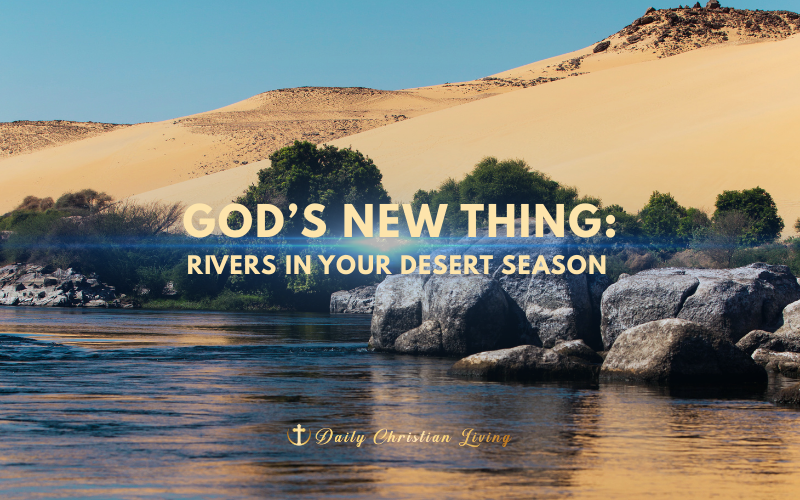
Every spring, God whispers the same message He spoke through the prophet Isaiah thousands of years ago: “Remember ye not the former things, neither consider the things of old. Behold, I will do a new thing; now it shall spring forth; shall ye not know it? I will even make a way in the wilderness, and rivers in the desert.” Isaiah 43:18–19
The Apostle Paul echoes this truth with stunning clarity in 2 Corinthians 5:17: “Therefore if any man be in Christ, he is a new creature: old things are passed away; behold, all things are become new.”
With Easter approaching, we are reminded that this is not poetic sentiment. The empty tomb proves it. The same God who rolled away the stone is in the business of rolling away every barrier between you and the new thing He has prepared.
Whether you are eighteen or eighty, stepping into a new chapter or clinging to the last page of an old one, God’s promise stands: He is doing something new, and it is already springing forth.
What Is God Really Saying in Isaiah 43:18–19?
To understand the weight of these verses, we need to feel the force of each phrase. Isaiah 43:18–19 offers both a theological declaration and a practical directive for every believer navigating the transition between seasons of life.
At first glance, the command to “remember ye not the former things” seems strange.
Doesn’t scripture tell us to remember what God has done? Absolutely. The Israelites were repeatedly told to remember their deliverance, to set up memorial stones, to teach their children about God’s faithfulness. But the Hebrew word for “remember” (zakar) here carries the idea of being mentally consumed by something.
God is not erasing history. He is telling us to stop being so fixated on the past—whether its glories or its failures—that we cannot see what He is doing right now.
Solomon captured this same principle in Ecclesiastes 7:10: “Say not thou, What is the cause that the former days were better than these? for thou dost not enquire wisely concerning this.”
There is a difference between gratitude for the past and imprisonment by it. Gratitude (for what God has done for you in the past) builds faith for the future. Nostalgia idealizes yesterday and breeds discontentment for today.
Then comes the declaration: “Behold, I will do a new thing; now it shall spring forth.” The word “behold” is God grabbing us by the shoulders and saying, “Pay attention!” The Hebrew word for “spring forth” (tsamach) is the same word used elsewhere to describe a plant breaking through the soil.
God’s new work in your life is not mechanical—it’s alive, and it’s already germinating beneath the surface, even if you cannot see it yet.
Then comes the gentle challenge: “Shall ye not know it?” Will you recognize it when it arrives, or will you be so busy staring in the rearview mirror that you miss the road God is building right in front of you?
Finally, God tells us exactly what kind of new thing He specializes in: the impossible kind. A roadway in the wilderness—where no path exists. Rivers in the desert—where water has no business flowing. This is God’s signature.
God doesn’t merely repair; He resurrects. And Isaiah 43:21 tells us the reason: “This people have I formed for myself; they shall shew forth my praise.” His supernatural intervention is designed to leave you with one response: worship.
How Does Being “In Christ” Make All Things New?
Isaiah’s promise finds its ultimate fulfillment in Jesus Christ. When Paul writes in 2 Corinthians 5:17 that anyone in Christ is a “new creature,” he is not speaking in metaphor. The Greek word for “new” (kainos) does not mean new in time—like a newer model of the same car. It means new in kind—something that has never existed before.
When you placed your faith in Jesus Christ, you did not receive a renovation. You received a resurrection. The old identity, the old standing before God, the old slavery to sin—all of it passed away. A completely new creation took its place.
This is the theological backbone of every fresh start God offers. Because you are a new creature in Christ, God’s pattern for your life is renewal, not recycling. He is not patching up your old life with good intentions. He is building something brand new. And this renewal is ongoing.
Romans 12:2 commands: “And be not conformed to this world: but be ye transformed by the renewing of your mind, that ye may prove what is that good, and acceptable, and perfect, will of God.”
Every morning, God’s mercies are fresh. Lamentations 3:22–23 confirms: “It is of the LORD’s mercies that we are not consumed, because his compassions fail not. They are new every morning: great is thy faithfulness.”
The God who makes all things new does not run out of new mercies.
Who Needs to Hear This Promise Right Now?
The beauty of Isaiah 43 is that it meets people in every season. The wilderness is not reserved for one demographic. The same God who promises rivers in the desert is speaking directly to your situation, wherever you are.
The Student Facing an Uncertain Future. You’re about to graduate, and the familiar routines are ending. The future feels like a wilderness of unknowns. But God says, “Behold, I will do a new thing.” He has already prepared the path. Jeremiah 29:11 is not just a poster verse: “For I know the thoughts that I think toward you, saith the LORD, thoughts of peace, and not of evil, to give you an expected end.”
The Parent Watching Children Leave. The house that once echoed with laughter is suddenly quiet. The “empty nest” feels less like freedom and more like a desert. But this is not the end. God has new purpose for this chapter—new ministry, new depth in your marriage, new opportunities to invest in others. The nest may be empty, but your life is not.
The Believer Walking Through Grief. You’ve lost someone dear, and the grief is crushing. Every familiar thing reminds you of what is gone. But God, who is close to the brokenhearted (Psalm 34:18), promises that weeping has an expiration date. Psalm 30:5 assures us: “Weeping may endure for a night, but joy cometh in the morning.” Your morning is coming.
The Senior Facing a New Chapter. Perhaps you are retiring or moving from the home you’ve lived in for decades. Everything familiar is being stripped away. But consider Abraham—called to a new beginning at seventy-five. Sarah bore Isaac when Abraham was one hundred (Genesis 21:5).
God is never done with you. Your age is no barrier to His purposes. The God who walks the unfamiliar road with you is the same yesterday, today, and forever (Hebrews 13:8).
How Does God Build Roads Where None Exist?
This is where we must move beyond motivational thinking and into the realm of the supernatural. Isaiah 43:19 is not a pep talk. It is a declaration of divine power. Consider the pattern of scripture—when things looked most hopeless, God moved most powerfully:
- The Red Sea (Exodus 14:21–22): Two million people trapped between an army and an ocean. No escape. And God made a road on the sea floor.
- Water from the Rock (Exodus 17:6): A bone-dry desert, no wells, no rain. God told Moses to strike a rock, and water poured out for an entire nation.
- The Valley of Dry Bones (Ezekiel 37:1–10): Skeletal remains filling a valley. No sign of life. God commanded the bones to live, and an army rose from the grave.
- The Empty Tomb (Matthew 28:6): A crucified Savior in a sealed tomb. Every earthly hope lay dead. And on the third day, God rolled the stone away.
This is the God who promises to do a new thing in your life.
He doesn’t need raw materials. He creates something from nothing. And most often, He waits until we are desperate enough to recognize that when the breakthrough comes, it could only have been Him.
As Romans 8:28 assures us: “And we know that all things work together for good to them that love God, to them who are the called according to his purpose.” The wilderness is not wasted. The desert is not pointless. God is weaving every dry, difficult season into a tapestry of good.
Why Does Easter Prove This Promise Is Real?
Easter is not merely a holiday; it is the supreme evidence that God does what He promises. The resurrection of Jesus Christ is the ultimate “new thing”—the moment when God took the worst event in human history and turned it into the best. What looked like defeat was victory. What appeared to be an ending was a beginning.
The disciples had given up. Peter went back to fishing (John 21:3). Thomas was drowning in doubt (John 20:25). The men on the road to Emmaus walked with crushed spirits (Luke 24:17).
They were living in the past, unable to see the staggering new thing God was doing right under their noses. And then the risen Christ appeared. Everything changed. He made a way through death itself and opened rivers of living water that would flow forever, just as He promised in John 7:38: “He that believeth on me, as the scripture hath said, out of his belly shall flow rivers of living water.”
If God can raise His own Son from the dead, He can certainly breathe life into your dead situation. Easter is living proof that no season is final for those who belong to Christ.
What Should You Do with This Promise Today?
God’s promise in Isaiah 43 is not meant to be admired from a distance. It is meant to be claimed, prayed, and lived. Here is how to anchor your soul in this truth.
Name Your Wilderness. Get specific with God. Write down the area of your life that feels like a desert. When blind Bartimaeus cried out to Jesus in Mark 10:51, the Lord asked, “What wilt thou that I should do unto thee?” Jesus knew what he needed, but He wanted Bartimaeus to say it out loud. Name your wilderness and hand it to God.
Pray the Promise Back to God. Turn Isaiah 43:19 into a personal prayer: “Lord, you promised to do a new thing. Make a way through this wilderness. Send rivers into this desert. Open my eyes so I don’t miss what You’re doing.” Isaiah 55:11 guarantees His Word will accomplish what He pleases.
Release the Past. Whether your past is marked by trauma, failure or golden days you cannot let go of, God is telling you to release your grip. Paul modeled this in Philippians 3:13–14: “Brethren, I count not myself to have apprehended: but this one thing I do, forgetting those things which are behind, and reaching forth unto those things which are before, I press toward the mark for the prize of the high calling of God in Christ Jesus.” The prize is ahead of you, not behind you.
Trust the Timing. God’s new thing will spring forth on His timetable, not ours. The crocus does not bloom in January. Habakkuk 2:3 counsels: “For the vision is yet for an appointed time, but at the end it shall speak, and not lie: though it tarry, wait for it; because it will surely come, it will not tarry.” Wait on the Lord. His timing is impeccable, even when it feels unbearably slow.
Nothing Is Too Late, and No One Is Too Far Gone
God took a barren, hundred-year-old man named Abraham and made him the father of nations. He took Moses, an eighty-year-old fugitive tending sheep in the desert, and sent him to liberate a nation. He took a crucified, buried Savior and raised Him to eternal glory on the third morning.
It does not matter how long your winter has lasted or how barren your desert looks. The God who specializes in making roads where none exist and sending rivers where no water flows is the same God who holds your life in His hands. And He says to you today: “Behold, I will do a new thing; now it shall spring forth; shall ye not know it?”
Know it. Believe it. Watch for it. And when it comes—because it will—give Him the glory.
Father, we come before You with open hands and expectant hearts. Forgive us for clinging to the past when You are calling us forward. Open our eyes to see the new thing You are doing, even now, beneath the surface of our circumstances. Build Your road through our wilderness. Send Your rivers into our desert. Renew us day by day as new creatures in Christ, and remind us that the same resurrection power that raised Jesus from the dead is alive and at work in our lives today. In Jesus’ name, Amen.
No responses yet